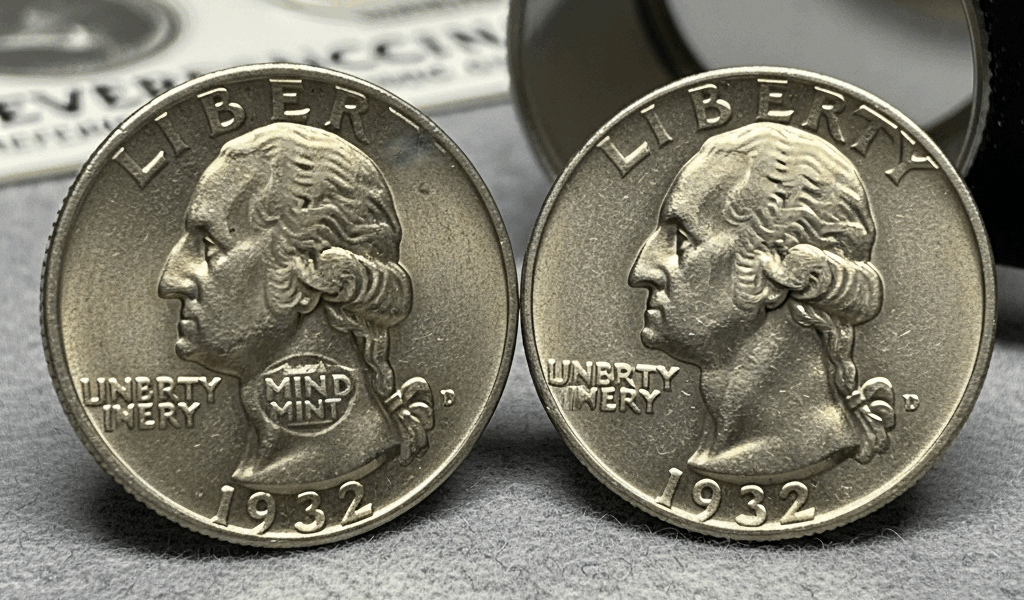
Why the 1932-D Washington Quarter Matters
Washington quarter collecting has gotten complicated with all the misinformation flying around — especially when it comes to key dates and what they’re actually worth. As someone who has spent years haunting coin shows, pestering dealers, and buying raw quarters out of dusty binders, I learned everything there is to know about the 1932-D. Today, I will share it all with you.
The 1932-D Washington quarter is the single most valuable key date in the entire series. Period. But what is a key date, really? In essence, it’s a coin with low enough mintage and high enough demand that the market treats it differently than everything around it. But it’s much more than that — it’s a story about bad timing, economic collapse, and a Denver Mint that only struck 436,800 pieces before production shifted elsewhere. Most of those coins circulated hard through the Great Depression, shoved in pockets, dropped on counters, worn smooth by a decade of economic desperation. Finding one today in decent shape is genuinely difficult. That’s what makes the 1932-D endearing to us collectors.
So, without further ado, let’s dive in.
1932-D Quarter Value by Grade
These figures come from recent PCGS and NGC population data, Heritage Auctions results from 2023–2024, and direct conversations with dealers. Not price guides from 2019. Actual market, right now.
Circulated Grades
- Good-4 (G-4): $45–$65. Heavy wear throughout. Date and mintmark are still readable, but most finer details have flattened out entirely.
- Very Good-8 (VG-8): $70–$110. You can see the design outline clearly. Major details worn flat.
- Fine-12 (F-12): $120–$180. Hair strands and eagle feathers show some definition. Obviously circulated, but honestly respectable for the date.
- Very Fine-20 (VF-20): $200–$320. Sharp major details, wear only on the highest points. This is where most raw 1932-D quarters land when people drag them out of old collections.
- Extremely Fine-40 (EF-40): $450–$650. Wear limited to the very highest points. Some luster still present. Scarce in this grade — genuinely scarce, not dealer-marketing scarce.
- About Uncirculated-50 (AU-50): $700–$1,200. Barely kissed by circulation. Nearly full mint luster visible if you tilt it under a single light source.
Mint State Grades
- MS-60: $1,100–$1,800. Uncirculated, but bag marks and weak luster hold it back.
- MS-61: $1,400–$2,200. Fewer contact marks. Luster improving noticeably.
- MS-62: $1,800–$2,800. Clean surfaces, good cartwheel luster. Most desirable entry point for non-specialists who want a Mint State example without paying gem premiums.
- MS-63: $2,500–$4,200. Attractive coin. Minimal marks even under 5x magnification.
- MS-64: $4,500–$7,000. Gem quality. True investment-grade. Rare enough that dealers get excited when one walks through the door.
- MS-65 and Above: $9,000–$18,000+. Extremely rare. Only a handful certified at this level exist. Price discovery happens at auction — results vary wildly depending on who’s bidding that day.
Don’t make my mistake. I initially assumed circulated 1932-D quarters were relatively common because I saw a dozen listed on various dealer sites simultaneously. I was wrong. When I started calling dealers directly asking what they had physically in stock, most had zero — or maybe one raw example sitting in a back drawer they’d taken in on trade six months earlier. “Listed price” and “actually available” are two completely different markets. Remember that.
How to Spot a Genuine 1932-D Quarter
Altered mintmarks are real, and this problem goes back decades. Scammers have been adding a D to 1932-P Philadelphia quarters since at least the 1960s — probably earlier — because the price gap is substantial enough to make the effort worthwhile.
The Genuine Mintmark
On a real 1932-D, the D sits below the eagle’s tail feathers on the reverse, positioned slightly right of center. It’s sharp, clearly raised, and consistent in depth with the surrounding design elements. That’s because it was punched into the working die before the coin was ever struck — not added afterward by someone with a tool and questionable intentions.
On an altered coin — typically a 1932-P with a D grafted on — the mintmark sits shallow. Sometimes slightly off-center. Under a 5x or 10x loupe you’ll sometimes see file marks, solder residue, or disturbed metal around the base of the letter. The edges may look slightly fuzzy or indistinct. Any 1932-D you’re considering buying should have a D that looks like it absolutely belongs there, inseparable from the design itself.
Cleaning Red Flags
Cleaning is rampant on this date. Probably should have opened with this section, honestly. Raw 1932-D quarters in VF-20 or better represent serious money, and someone along the 90-year ownership chain might have dipped it hoping to bump the sale price.
Signs of cleaning include:
- Unnatural uniform luster — almost plastic-looking under light, lacking the organic variation of original surfaces.
- Hairline scratches visible under 4x magnification, running in one consistent direction across the fields.
- Loss of original patina — that subtle grey-brown “bloom” naturally circulated silver develops over nine decades.
- Overly bright fields that contrast sharply and unnaturally against the design elements.
When to Get It Certified
PCGS or NGC certification might be the best option, as the 1932-D specifically requires independent authentication. That is because altered mintmarks and cleaned examples are common enough that raw coins carry real uncertainty — uncertainty that costs you money when selling. If your coin is worth more than about $100, professional grading almost always makes financial sense. Both services use multiple experts and reject problem coins at submission. A certified example commands 10–25% more than a raw coin of equivalent quality — buyers simply trust the slab.
What Dealers Pay Versus What You See Listed
Here’s the part that genuinely surprises most people the first time they try to sell a key date.
Retail price guides show what collectors pay each other. Not what dealers pay when buying from the public. Those are different numbers — sometimes dramatically different.
A raw 1932-D grading VF-20 might be listed at $250 on a dealer’s website or in a standard price guide. That same dealer buying your coin will offer $100–$150. Why? They need to evaluate it themselves, store it, photograph it, market it, and still profit at the end. They’re acquiring a retail asset — they can’t pay retail prices to do that.
Certified examples change the math. A PCGS VF-20 1932-D will get you $220–$280 from a dealer because the authentication and grading work is already done. They can turn it around faster and with less risk. That’s the economic argument for certification.
A Real Example
Let’s say you have a raw 1932-D you’ve examined carefully and believe grades VF-20. Retail asking price: around $250. Here’s what actually happens when you try to convert that to cash:
- Walk into a local coin shop: $110–$140. Quickest exit, lowest offer. The dealer is compensating for uncertainty about grade and originality.
- Mail it to a mid-sized dealer: $140–$180. They’ll verify the grade themselves, sit on it briefly, still need margin.
- Submit to PCGS, then sell the slab to a dealer: $210–$250. Certified, easy to resell, minimal friction.
The grading submission fee runs $25–$35 depending on service tier and current PCGS pricing. That cost gets absorbed by the certification premium at VF-20 and above. If the coin comes back F-12 instead — lower than you estimated — the premium shrinks and you might roughly break even on the grading cost. I’m apparently an optimistic grader, and submitting first rather than selling raw works for me while the “just sell it quick” approach never actually did.
Should You Get It Graded or Sell It Raw
First, you should figure out roughly where your coin grades — at least if you want to make a rational decision here. Then run through these scenarios.
Scenario 1: Your Coin Is VF-20 or Better, No Cleaning
Get it certified. The premium justifies the cost by a comfortable margin. A VF-20 raw coin might net $150 at a dealer. Certified, that same coin nets $230 or better. That’s an $80 gain against a $30 grading fee.
Scenario 2: Your Coin Is F-12 to VF-20, Possible Light Cleaning
This is the danger zone. PCGS or NGC might grade it lower than your estimate, or they might net-grade it “details” for cleaning — which kills the premium entirely. If you’re confident in the coin’s originality, submit it. If you’re genuinely uncertain, selling raw might be smarter. The dealer spread at F-12 is narrow enough that grading costs eat into whatever you’d gain.
Scenario 3: Your Coin Is G-4 to F-12, Heavily Worn
Sell it raw. Certification doesn’t add enough premium at these lower grades to justify a $30 submission fee. You’ll net $50–$100 either way — don’t pay to grind away the difference.
Scenario 4: You’re Unsure About Authenticity
Get it certified. That’s precisely what the service exists for. If it fails authentication, you’ve learned something important before losing real money. If it passes, you’ve added credibility worth far more than the submission fee.
The 1932-D Washington quarter remains the king of the series for a reason. Low mintage, high collector demand, and genuine scarcity across all grade levels combine to create real, sustained value. Know your grade. Verify authenticity — seriously, check that mintmark carefully. Understand what dealers will actually pay versus what price guides say. That’s the collector’s edge, and it’s available to anyone willing to do the work before they sell.



Stay in the loop
Get the latest numisma news updates delivered to your inbox.