Why Did US Dimes Stop Being Silver in 1965? The History Behind the Change
Silver dimes have gotten complicated with all the misinformation flying around about why they disappeared. As someone who’s spent years sorting through estate sale coin jars and flea market boxes, I learned everything there is to know about the 1965 coinage switch — and the real story is messier and more interesting than the textbook version. It wasn’t some quiet bureaucratic shuffle. It was a genuine fiscal emergency, complete with a televised presidential ceremony, Treasury officials in full panic mode, and millions of ordinary Americans suddenly raiding their sock drawers. Let me walk you through what actually happened.
The Silver Shortage That Forced the Change
By the early 1960s, the US was quietly bleeding silver. Not all at once — but the math had become impossible to ignore.
Three separate problems were converging at once. Industrial silver demand had exploded well beyond anyone’s postwar projections. Photography alone was consuming enormous quantities — every roll of Kodak Ektachrome required silver compounds in its emulsion. Electronics manufacturers needed silver contacts and conductors. The postwar industrial economy was devouring silver in ways nobody had thought to plan for back in 1945 when the Roosevelt dime first hit circulation.
Meanwhile, foreign governments and international speculators had noticed something deeply embarrassing about American coinage. US dimes, quarters, and half dollars were 90% silver. When spot silver prices climbed past a certain point on global markets, those coins were worth more as raw metal than as money. So that’s exactly what happened — bags of US coins got purchased at face value, shipped overseas, and melted for bullion. Legal. Rational. A slow disaster for the Treasury.
The third issue was pure volume. The US money supply kept expanding — more people, more transactions, more coins needed. The mint couldn’t keep pace with silver production even without the other two problems dragging on supply.
By 1964, the Treasury was spending more than ten cents in raw silver just to manufacture a single dime. Sit with that for a second. The government was losing money on every coin it struck. The Coinage Act of 1965 wasn’t ideology — it was arithmetic that had finally won the argument.
LBJ Signs the Coinage Act — The Day Silver Coins Ended
President Lyndon B. Johnson signed the Coinage Act of 1965 on July 23rd — a ceremony broadcast on national television. That detail matters. The administration knew this was going to land badly, and Johnson handled it with the kind of bluntness he was apparently famous for.
He stood at that podium and essentially said: yes, we’re changing the coins, no, your old silver coins won’t become worthless, and the people predicting catastrophe are wrong. He called out coin hoarders by name — almost daring them. He promised silver coins already in circulation would remain legal tender indefinitely. They technically still are.
The new composition mandated by the Act was copper-nickel clad. Dimes and quarters got a pure copper core sandwiched between outer layers of copper-nickel alloy. Half dollars received a partial concession — 40% silver through 1970 — then switched to copper-nickel clad after that.
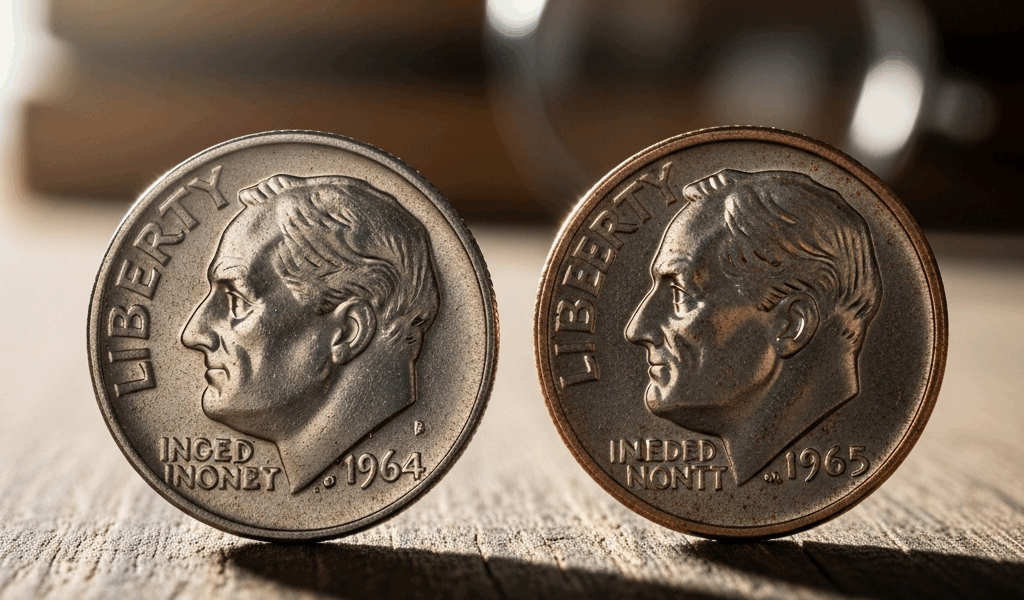
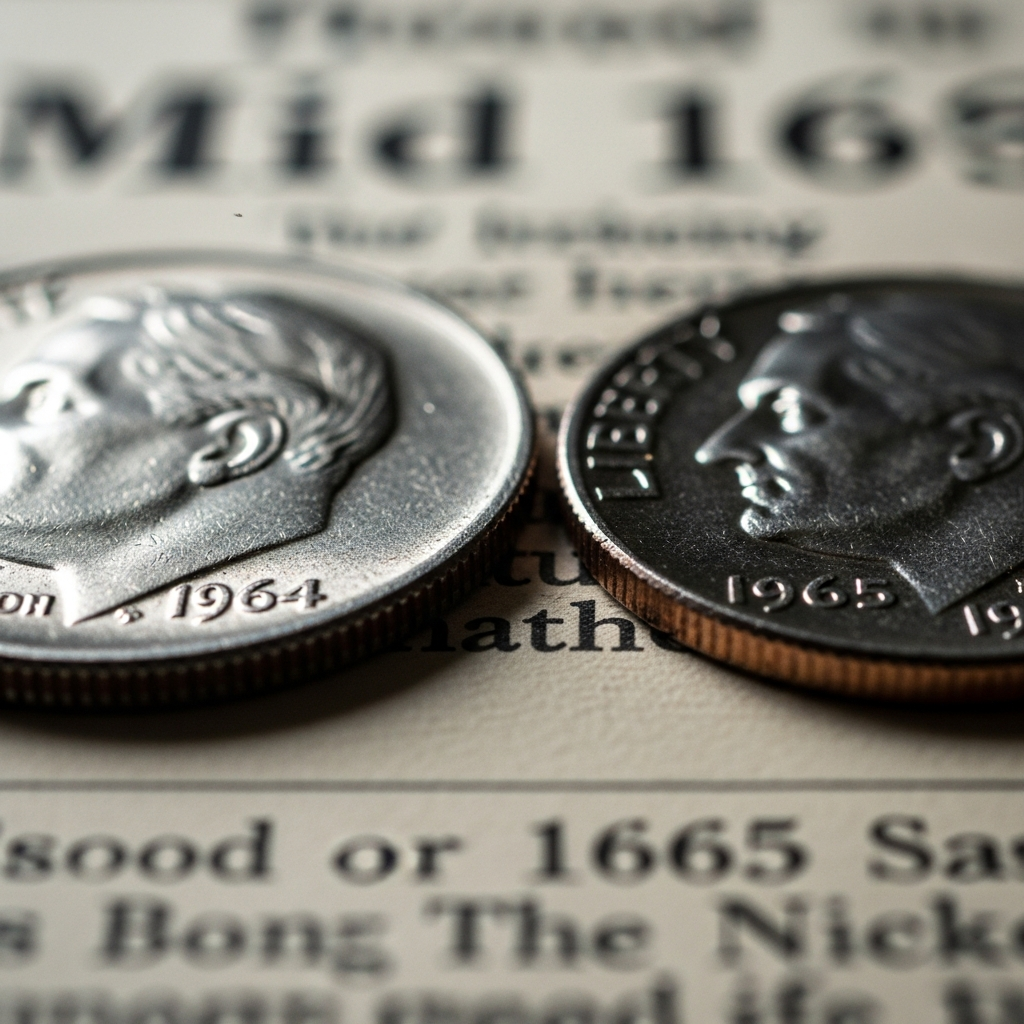
There’s a dead-simple way to tell old from new in your hand. Flip a pre-1965 dime on its edge. Solid silver color, all the way around. Now flip a post-1965 dime. You’ll see a thin copper stripe running the circumference — the copper core peeking through. That stripe is the giveaway. I’ve watched dealers at coin shows run this check in half a second without even glancing up from whatever they’re doing. Once you’ve done it a few hundred times yourself, it becomes pure muscle memory.
The Hoarding That Happened Almost Overnight
Probably should have opened with this section, honestly — because this is where history becomes something you can actually watch happen rather than just read about.
The moment the Coinage Act was announced, Americans started pulling silver coins out of circulation with remarkable speed. But what is Gresham’s Law? In essence, it’s the economic principle that bad money drives out good. But it’s much more than that — it’s a description of basic human behavior. When two currencies of nominally equal value circulate together, people spend the less valuable one and hoard the more valuable one. The “bad” money dominates commerce. The “good” money vanishes into coffee cans and coat pockets.
That’s what makes this moment endearing to us collectors — you can actually pinpoint the transition on a timeline and watch Gresham’s Law execute itself in real time across an entire economy.
Between 1965 and 1968, pre-1965 silver dimes and quarters disappeared from American commerce at a speed that genuinely surprised observers. By 1967, finding a silver dime in your change was unusual. By 1968, genuinely rare. The whole transition took less than three years.
Captivated by a coffee can of loose change my grandfather handed me sometime around 1987, I spent an afternoon pulling out every dime and checking the edge — and even then, two full decades after the Coinage Act, finding a silver Roosevelt dime in a random jar felt like finding a small buried treasure. It was. Here’s the math at current silver prices around $28 per troy ounce: a pre-1965 Roosevelt dime contains 0.0723 troy ounces of silver. That’s a melt value of roughly $2.02. Face value is ten cents. Every pre-1965 dime sitting in a jar is worth approximately twenty times what’s stamped on its face. The hoarding was completely rational behavior — then and now.
Pre-1965 Roosevelt Dimes — What Collectors Actually Value
Roosevelt dimes ran from 1946 through 1964 in 90% silver. The design — Franklin Roosevelt’s profile, sculpted by John Sinnock — has appeared on the dime continuously since 1946, though everything post-1965 is clad copper.
Here’s something that trips up newer collectors: uncirculated pre-1965 Roosevelt dimes are not rare. They’re abundant — and the reason is almost circular. People hoarded them starting in 1965, and hoarded coins don’t get worn. Entire bags of 1964 Roosevelt dimes got pulled from bank rolls and saved specifically for the silver. A roll of 50 uncirculated 1964 Roosevelts runs roughly $100 to $120 at current spot. That’s bullion math, not collector scarcity.
Most circulated pre-1965 Roosevelt dimes trade at or just slightly above silver melt. Common dates in Fine or Very Fine condition — you’re paying maybe 10 to 15 cents over spot per coin. Nothing dramatic.
The dates that carry genuine premiums above silver are the lower-mintage issues: 1949-S, 1950-S, and 1951-S. Fewer coins struck, real collector demand in uncirculated grades — these aren’t just bullion math.
One more thing worth knowing — the FB designation. Full Bands refers to Roosevelt dimes where the horizontal bands on the torch in the reverse design are completely and sharply split. Finding that on a 1950-S or 1949-S can push value to $50 or $200 above silver content depending on grade. PCGS and NGC both certify it. Worth checking if you’re pulling uncirculated examples from old bank rolls.
Mercury Dimes vs Roosevelt Dimes — What Predates 1946
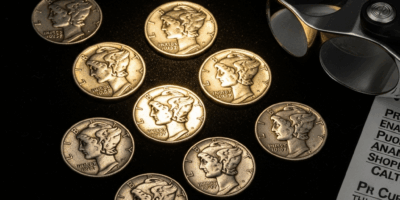
Same 90% silver composition. Completely different design. Mercury dimes ran from 1916 through 1945 — and the name is technically wrong. The figure on the obverse is Lady Liberty wearing a winged Phrygian cap, not the Roman god Mercury. The wings represent freedom of thought. The resemblance to Mercury’s winged helmet made the nickname stick anyway, and apparently nobody was ever going to let accuracy get in the way of a good nickname.
Key Mercury dime dates worth knowing:
- 1916-D — Only 264,000 struck at the Denver Mint. In Very Fine-20 condition, expect $800 to $1,500 depending on current market. This is the Holy Grail of the series — full stop.
- 1921 and 1921-D — Low-mintage years from the post-World War I economic contraction. Both carry strong premiums in higher grades.
- Common 1940s dates — Worth silver melt plus $1 to $3 in circulated grades. Nothing special, but still silver.
Don’t make my mistake. Early on I went straight for Mercury dimes — spent more than I should have on a mediocre 1942/41 overdate that turned out to be a cleaned example. The hairlines were there under magnification; I just didn’t know to look for them before handing over cash. Lesson learned the expensive way: always examine the fields under a loupe before committing to anything above spot price. Always.
For anyone starting out with silver dimes now, Roosevelt dimes from 1946 to 1964 might be the best entry point, as the series requires less specialized knowledge to navigate. That is because cleaned and problem coins are easier to spot, original uncirculated examples are widely available, and cost per coin stays manageable. Mercury dimes reward collectors who want to build a complete date-and-mint set and have patience for the 1916-D problem. Both series share the same silver. Both stopped being made the same year. Both vanished from American pockets for exactly the same reason — the summer of 1965, a televised signing ceremony, and arithmetic that finally caught up with a monetary system that had been running on borrowed time.


Stay in the loop
Get the latest numisma news updates delivered to your inbox.