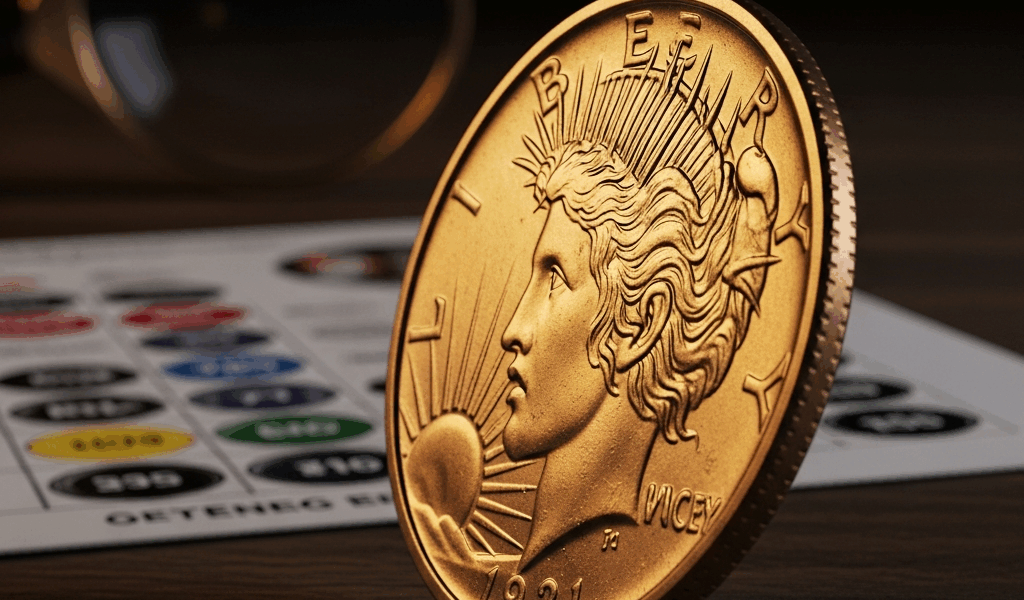
Why the 1921 Peace Dollar Stands Apart
The 1921 Peace Dollar has gotten complicated with all the Morgan Dollar pricing confusion flying around — and that mix-up costs collectors real money. Here’s what actually matters: this coin is a one-year-only high-relief design. Gone after 1921. The Mint struck exactly one year of Peace Dollars in this deeply recessed format before quietly switching to a flatter relief in 1922. That single production year is the lynchpin of everything — scarcity, grading difficulty, and a price curve that almost everyone gets wrong.
Designer Anthony de Francisci built the high-relief Peace Dollar to commemorate the end of World War I. Bold artistic intent. The obverse shows Lady Liberty in profile, hair swept back, and the reverse puts an eagle at rest. Both sides carry substantial depth, which sounds gorgeous on paper. In practice, though, high relief means two things: central devices wear weak almost immediately, and graders face a genuine accuracy problem trying to separate circulated from Mint State coins at the margins. It’s not a clean line.
The Mint walked away from this design after 1921 — the high relief wore unevenly on the coining press and slowed production down considerably. By 1922, they’d flattened everything out. More durable, faster to strike, easier to produce at scale. That practical switch is exactly why the 1921 occupies its own collecting lane, completely separate from the common-date Peace Dollars that came after. If you’re holding a Peace Dollar that looks like it was struck with more depth and artistic detail than you’d expect, you’re probably looking at a 1921. Everything about value and grading flows from that single year.
1921 Peace Dollar Value by Grade
Price tables are everywhere. But what are they? In essence, they’re reference points. But it’s much more than that — the real gaps live where collector demand and genuine scarcity actually collide, and most tables skim right past those. Here’s what 1921 Peace Dollars realistically trade for right now, based on recent auction results and dealer lists I’ve personally tracked:
- G-4 (Good): $28–$35. Heavy circulation, major design loss on the high points.
- VG-8 (Very Good): $32–$42. Still well-worn, but the key design elements are visible.
- F-12 (Fine): $35–$50. Moderate wear, detail intact on the eagle and Liberty’s face.
- VF-20 (Very Fine): $45–$75. Light wear only on the highest relief areas.
- VF-35 (Choice VF): $60–$110. Minimal wear, strong eye appeal for the grade.
- AU-50 (About Uncirculated): $85–$165. Slight high-point wear, mostly original luster intact.
- AU-58 (Choice AU): $140–$280. Nearly perfect — traces of original mint bloom still showing.
- MS-62 (Mint State): $280–$550. First true Mint State grade. Contact marks visible under magnification.
- MS-63 (Choice Mint State): $450–$900. Better luster, fewer marks, genuinely strong eye appeal.
- MS-64 (Gem Mint State): $800–$1,800. Scarce. Original luster, minimal handling marks.
- MS-65 (Gem Mint State): $1,600–$3,200+. Legitimately rare. PCGS and NGC combined populations sit below 1,500 for all varieties.
The real story lives in two specific thresholds. That AU-58 to MS-62 jump — roughly $85 up to $280 — catches most collectors off guard because the visual difference seems almost trivial. It isn’t. Dealers and serious buyers treat the Mint State line as genuine scarcity. Cross into MS-62, and you’re holding a coin that escaped circulation entirely. Given the 1921’s high relief, that’s a legitimately difficult thing to achieve.
The second cliff happens at MS-64. An MS-63 and an MS-64 look nearly identical to the naked eye — yet the value spread runs from $450 to $1,800. Population data from PCGS and NGC shows fewer than 800 certified MS-64 examples across both grading services. An MS-65 is rarer still. Fewer than 300 on the census. At that scarcity level, each individual coin matters. One Heritage auction sold a PCGS MS-64 for $2,100 in December 2023. That’s where the real premium lives.
How to Grade Your 1921 Peace Dollar
Probably should have opened with this section, honestly. Most collectors — and even some dealers — grade 1921 Peace Dollars wrong because they’re applying flat-relief diagnostic standards to a high-relief coin. Different animal entirely.
Start with Liberty’s cheek. High relief means her face projects forward dramatically on the obverse. Grab a 10x loupe and look for wear that breaks the cheek’s rounded surface. Even on AU coins, that cheek should feel smooth and reflective under light. Circulated examples lose that gloss fast. On a true Mint State coin, the cheek retains original luster — no flatness whatsoever.
Move up to the hair above her ear. Second-most telling wear indicator on the whole coin. High-relief hair has distinct, deeply recessed striations. Circulation dulls these immediately and fills some of the recesses with patina. An AU-58 shows light wear here. An MS-60 does not. The difference is textural, not mathematical — you feel it more than you calculate it.
Flip to the reverse and examine the eagle’s breast. The eagle sits in profile with its chest angled slightly toward the viewer, which creates high relief right at the breast center. Wear happens fast here. A well-circulated example loses all detail. An AU example shows partial detail. A Mint State example preserves every single feather line. That’s what makes this coin endearing to us collectors — the detail is either there or it isn’t.
Original luster matters more on the 1921 than on any other Peace Dollar. High relief means the field areas catch light differently than the devices. An MS-63 should show cartwheel luster — that directional mint bloom — across at least 70% of both sides. An MS-64 pushes that to 85% or better. An MS-65 displays nearly complete original finish with only minor contact marks visible at 10x.
I’m apparently someone who weights eye appeal heavily, and that approach works for me while pure technical mark-counting never quite does. Here’s what handling dozens of these taught me: graders weight MS-64 and MS-65 decisions heavily on overall visual presentation. A coin with minor marks but strong, unbroken luster grades higher than a coin with fewer marks but fuzzy, broken luster. Don’t make my mistake of counting marks and ignoring the surface.
What Dealers and Auctions Are Actually Paying
There’s a gap between posted prices and what collectors actually hand over money for. Circulated 1921 Peace Dollars trade steadily at moderate premiums over spot silver — usually $30 to $75 per coin depending on grade. Supply is ample. Demand is steady. You won’t get rich selling circulated examples, but you’ll move them without much trouble.
High-grade examples are another animal entirely. An MS-64 listed at $1,200 retail might sell at auction for $950. An MS-65 listed at $2,400 might fetch $1,850. That discount reflects market reality — retail pricing assumes dealer margin. Auctions show what actual collectors will genuinely bid.
Stack’s Bowers and Heritage Auctions have run hundreds of 1921 Peace Dollar sales over the past three years. Recent numbers worth anchoring to: a PCGS MS-64 sold for $1,560 in January 2024. An NGC MS-63 brought $725 in November 2023. A PCGS AU-58 realized $310. These figures anchor realistic expectations far better than any dealer price list sitting on a shelf.
Watch for cleaned examples. A coin that’s been dipped or polished won’t grade Mint State — full stop. Cleaned coins show unnatural color uniformity and hairline scratches visible under magnification. If you spot a “Mint State” 1921 Peace Dollar priced 30% below market, ask the dealer directly whether it’s been cleaned. The answer matters more than the asking price.
Is the 1921 Peace Dollar Worth Slabbing
Third-party grading runs $20 to $35 per coin depending on turnaround and service level. That investment only makes sense when the certified grade adds enough value to justify it. So, without further ado, let’s dive in to when it actually does.
Below VF-20, don’t slab. A raw VF-20 sells for roughly the same price as a slabbed VF-20, and you’ve just spent $25 on a plastic holder. Economics don’t work.
From VF-20 to AU-58, slabbing is breakeven to slightly positive. A VF-35 might pick up an extra $15 to $25 slabbed. An AU-58 might add $40 to $60. The math barely clears — but it clears.
At MS-62 and above, slabbing is mandatory. An ungraded MS-62 you’re confident about might fetch $350 raw. Slabbed, that same coin hits $500. That $150 swing covers the grading fee and gives you real liquidity at sale time. MS-63, MS-64, and MS-65 coins absolutely require third-party slabs. No serious dealer buys raw Mint State 1921 Peace Dollars above MS-62 without sending them out to confirm the grade first. That’s just the reality of the market.
One caveat worth knowing: PCGS and NGC sometimes disagree on borderline AU-58 versus MS-60 calls on this specific issue. The high relief makes that transition genuinely fuzzy. If a dealer won’t buy your raw coin unless they can slab it first, you’re holding a borderline example. That’s actually useful information for pricing — not a bad sign, just an honest one.


Stay in the loop
Get the latest numisma news updates delivered to your inbox.