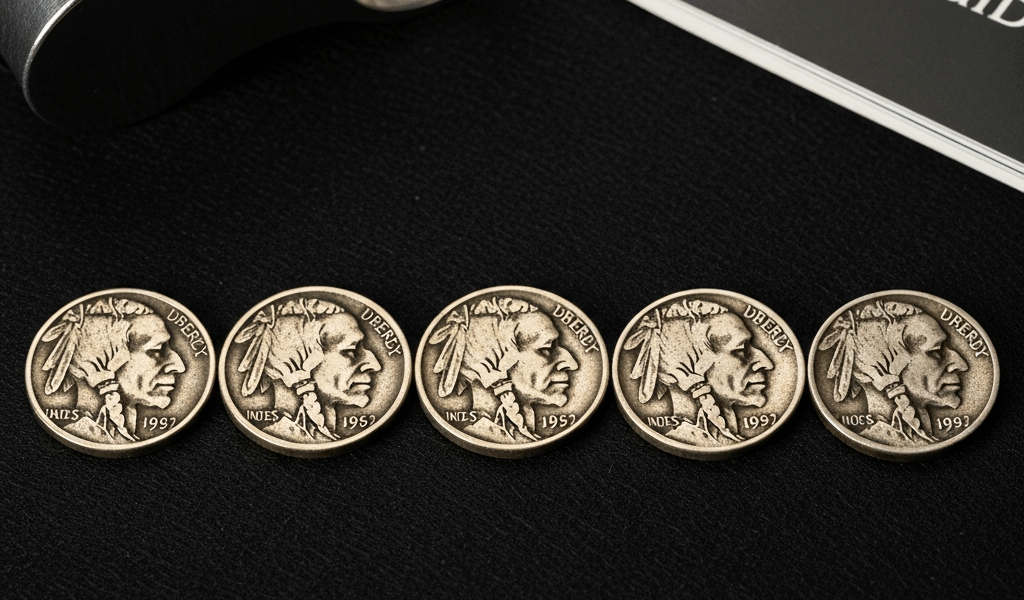
Why Buffalo Nickel Dates and Mint Marks Matter So Much
Buffalo nickel pricing has gotten complicated with all the misinformation flying around. I spent an entire afternoon at a coin show last year watching someone try to unload a Buffalo nickel for $8. The dealer squinted at it and offered 50 cents. The seller grabbed it back and stormed off. Two hours later — same afternoon, same show — somebody else walked up with a different Buffalo nickel. Also worn. Also beat up. Walked away with $120. The difference was the mint mark and the date. That’s it.
Buffalo nickels ran from 1913 to 1938. Three mints struck them: Philadelphia (no mark at all), Denver (D), and San Francisco (S). That tiny stamped letter — or the absence of one — can swing a coin from $3 to $300+. The date matters just as much. A 1937-D in average circulated condition might fetch $1.50. A 1916 Doubled Die Obverse in identical wear? You’re looking at $800 minimum. Same type of coin. Wildly different money.
Most people check the date and stop there. You need both — date AND mint mark — every single time. What follows is what these coins actually sell for in the real market. Not theoretical gem-condition fantasy prices. The prices you’ll actually encounter pulling coins from an old roll or sorting through an inheritance.
Key Dates Worth Real Money in Any Grade
These are the dates that make collectors’ hands shake a little. Even heavily worn examples command serious premiums — and that’s what makes them endearing to us collectors.
1913-S Type 2
The 1913-S Type 2 is legitimately scarce. But what is Type 2? In essence, it’s identified by the slightly raised ground beneath the Indian — a design modification made partway through 1913. But it’s much more than a cosmetic change; the mintage numbers dropped significantly. In AG-3 condition — heavily worn, maybe barely readable — you’re looking at $45–$65. Jump to VF-20, where light wear leaves major details visible, and you’re at $150–$250.
I bought one graded VF-25 at an estate sale for $180. The dealer who later authenticated it said fair market was closer to $320. Don’t make my mistake of jumping without checking recent sold comps first. That gap between distressed-sale pricing and actual market value is real, and it cuts both ways.
1916 Doubled Die Obverse
This is the heavyweight. The Indian side shows doubling on the date and on “LIBERTY” — look closely and you’ll see ghosted outlines sitting just outside the primary impression. A circulated example worn down to AG-3 still pulls $500–$700. VF examples regularly crack $1,200. PCGS- or NGC-graded specimens break $2,000 without hesitation.
Fair warning: fakes are everywhere. Unscrupulous sellers have taken plain 1916 nickels and attempted to simulate doubling through acid treatment or careful tooling. The real doubled die has crisp, consistent doubling across the entire design. Chemically produced fakes look blotchy — uneven, almost smeared. If you find one cheap online, it’s almost certainly altered. Walk away.
1918/7-D Overdate
An overdate happens when the Mint used a die stamped with the wrong year, then overstruck it with the correct one. The ghost of the original date stays visible beneath the new one. The 1918/7-D is the most famous Buffalo nickel overdate. AG-3 examples run $80–$120. VF-20 pieces move into the $300–$450 range.
Here’s where people consistently mess up: they spot a worn “18” and assume they’ve found the overdate. Check carefully. On a genuine 1918/7-D, there’s a clear “7” sitting underneath the “8” — visible without magnification under decent light. Wear alone never creates this effect. If you’re genuinely unsure, a dealer examination or grading submission is worth every penny of the fee.
1921-S and 1924-S
These San Francisco dates are quietly tough. The 1921-S exists in lower mintage numbers than most casual collectors realize. A worn example in AG-3 to G-4 runs $15–$25. VF-20 specimens jump to $80–$120. The 1924-S follows a similar pattern — $12–$18 in average wear, $60–$90 in VF.
Nothing flashy. Worth hunting for in rolls, though.
1926-S
The 1926-S punches well above its mintage numbers in terms of collector demand. AG-3 examples land at $8–$14. VF-20 runs $45–$75. I see these passed over constantly at shows because they don’t announce themselves as valuable — but they are. Pull them from mixed lots without hesitation.
Common Dates That Are Still Worth More Than Face Value
Probably should have opened with this section, honestly. Most Buffalo nickels you’ll encounter aren’t rare. But they’re not worthless either.
Philadelphia issues from 1930 to 1938 are extremely common. A 1935 no-mint in moderate wear — VF-20 — sells for $1.50–$2.50. Drop it to G-4 and you’re at 75 cents to $1.25. These coins won’t fund a vacation. They will, however, beat face value if they’re problem-free and original.
Here’s what kills value fast: cleaning, holes, corrosion, environmental damage. A cleaned Buffalo nickel — polished with a Dremel, rubbed with a harsh chemical, anything like that — drops 60–80% in value immediately. Dealers spot it instantly. The surfaces look artificially uniform, or there are tiny circular scratches under magnification. Leave your coins alone. Seriously. Don’t make my mistake of thinking a quick polish helps.
Buffalo nickels contain no silver — they’re 75% copper, 25% nickel. There’s no melt-value floor the way there is with 90% silver coins. The value is purely numismatic, driven by scarcity, condition, and demand. Nothing else.
Grading Worn Coins Yourself
While you won’t need professional certification for a $1.50 nickel, you will need a handful of basic tools — a 5x loupe, decent lighting, and a grading reference. First, you should check two specific areas — at least if you want an accurate read on what you’ve got.
- The buffalo’s horn — In VF-20, the tip is sharp and distinct. In G-4, it’s rounded off. In AG-3, it’s barely a suggestion of a horn.
- The Indian’s cheekbone — High-definition relief visible in VF. Softened but present in G-4. Nearly flat in AG-3.
If both details read clearly through a loupe under good light, you’re likely at VF or better. If one is mostly gone but the other survives, you’re probably somewhere in the G-4 to VG-8 range. That range matters — it’s often the difference between a $2 coin and an $8 coin on common dates, and a $60 coin versus a $150 coin on semi-keys.
The Dateless Buffalo Nickel Problem
You crack open a roll and pull out a Buffalo nickel with no visible date. This happens constantly — and it’s not always wear. The date sits on a high point of the design, right where circulation concentrates friction. Strike weakness also played a role; plenty of 1920s and 1930s coins left the Mint without a fully impressed date in the first place.
A fully dateless Buffalo nickel is worth 50 cents to $1.25 depending on overall eye appeal. That’s the ceiling. Collectors don’t pay premiums for mystery coins.
You’ll find acid-restoration tricks promoted online — the idea being that chemicals can “recover” a worn date. It doesn’t work. Not in any way that adds value or acceptability. Acid treatments may briefly reveal a ghost impression, but they damage the coin permanently. Dealers and grading services reject these on sight. Your dateless nickel is worth more untouched than chemically stripped.
Natural dateless coins show consistent, even patina across the entire surface. Treated coins look wrong — uneven color, darker splotches, a dull etched quality in the fields. If you bought one raw and genuinely can’t tell, a $15–$25 grading submission will confirm the answer fast. That might be the best option, as determining authenticity requires an expert eye. That is because the damage from acid treatment can be subtle enough to fool even experienced hobbyists on first glance.
Where to Sell or Buy Buffalo Nickels at Fair Prices
eBay completed listings are your reality check. Search “Buffalo nickel [date] [mint mark]” and filter by Sold listings — not active listings. Asking prices are garbage. Everyone dreams. Completed sales are fact. That’s what the market actually paid.
Coin shows might be the best option for quality key dates, as face-to-face negotiation requires no platform fees and no shipping risk. That is because dealers at shows carry lower overhead than online storefronts and often move inventory aggressively toward the end of the day. I’m apparently the type who hovers near tables during breakdown — and that approach works for me while bidding online never quite does. Picked up a 1916 in VF-20 for $850 at a show when the dealer was packing boxes. Same coin online would’ve been $1,200.
For anything with a realistic raw value above $100, professional grading through PCGS or NGC makes sense. Certification typically adds 15–30% to resale value. Below $100, grading fees — running $20–$30 per coin — eat too much of the upside. Keep raw coins in individual 2×2 flips or a small album. Don’t let them rattle loose in a drawer.
I’m apparently a PCGS person — their slightly stricter grading means a PCGS VF-20 often looks like what NGC would call VF-25, and that consistency works for me while the NGC label system never quite clicked. Both are reputable. For Buffalo nickels specifically, either service works fine. This site has a detailed breakdown of PCGS vs NGC if you want to dig into the specifics before submitting.

Stay in the loop
Get the latest numisma news updates delivered to your inbox.