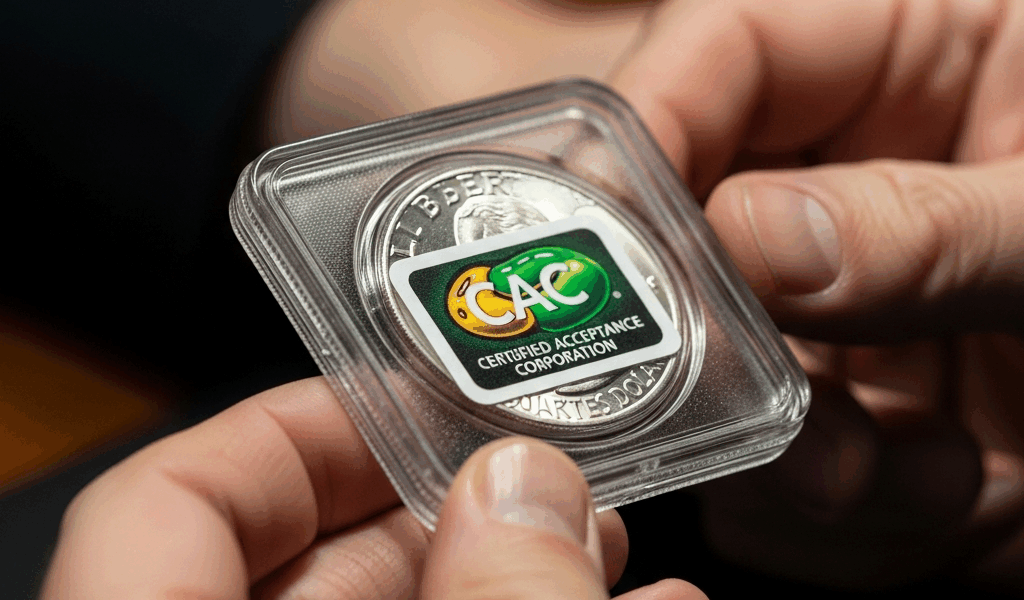
CAC Sticker Explained — What the Green and Gold Beans Mean for Your Coins
CAC sticker meaning has gotten complicated with all the misinformation flying around auction floors and online forums. As someone who lost real money ignoring one about six years back, I learned everything there is to know about what these little oval stickers actually signal. The coin was an 1881-S Morgan dollar at a regional show — seller wanted more than I thought made sense, I walked, and then watched it hammer at Heritage Auctions for nearly 40% above my mental ceiling. It had a gold CAC sticker. I hadn’t bothered to look closely enough to notice.
That one afternoon cost me more in education than any submission fee ever has.
If you’re staring at a graded coin with a green or gold oval on the slab and wondering what it actually means — practically, in dollars — you’re asking the right question. The Certified Acceptance Corporation’s official materials don’t make this easy to parse. So here’s what I wish someone had told me before that coin show.
What CAC Is and Why Collectors Care
But what is CAC? In essence, it’s a second-opinion service for already-graded coins. But it’s much more than that.
John Albanese founded Certified Acceptance Corporation in 2007 — working out of a small operation with a handful of trusted reviewers and a straightforward mandate. If the name rings a bell, it should. Albanese was one of the original architects of NGC before leaving to build something else entirely. When someone with that kind of resume launches a verification service, serious collectors don’t shrug it off.
The core problem CAC addresses is real. PCGS and NGC both grade on the 70-point Sheldon scale, and within any given grade, the range of actual quality is enormous. An MS64 Morgan dollar might be a soft, baggy piece that barely survived the jump from MS63 — or it might be a coin that missed MS65 by one stray bag mark on the reverse. Both carry identical labels. CAC exists to tell those two coins apart.
Approval means a small oval sticker — called a “bean” for obvious reasons — gets applied directly to the PCGS or NGC holder. The grade on the slab doesn’t change. The bean just signals that an experienced reviewer looked at that specific coin and decided it’s a genuine, above-average example of its assigned grade.
One hard rule: CAC only stickers coins already housed in PCGS or NGC holders. Raw coins, coins in other third-party slabs — those don’t qualify. That creates a defined ecosystem, which matters when you’re making real buying decisions.
That’s what makes CAC endearing to us serious collectors — it filters the noise that grading inconsistency creates, and it does it through a credentialed human review rather than an algorithm.
Green Bean vs. Gold Bean — The Difference
Probably should have opened with this section, honestly, because the color distinction is where most people get turned around.
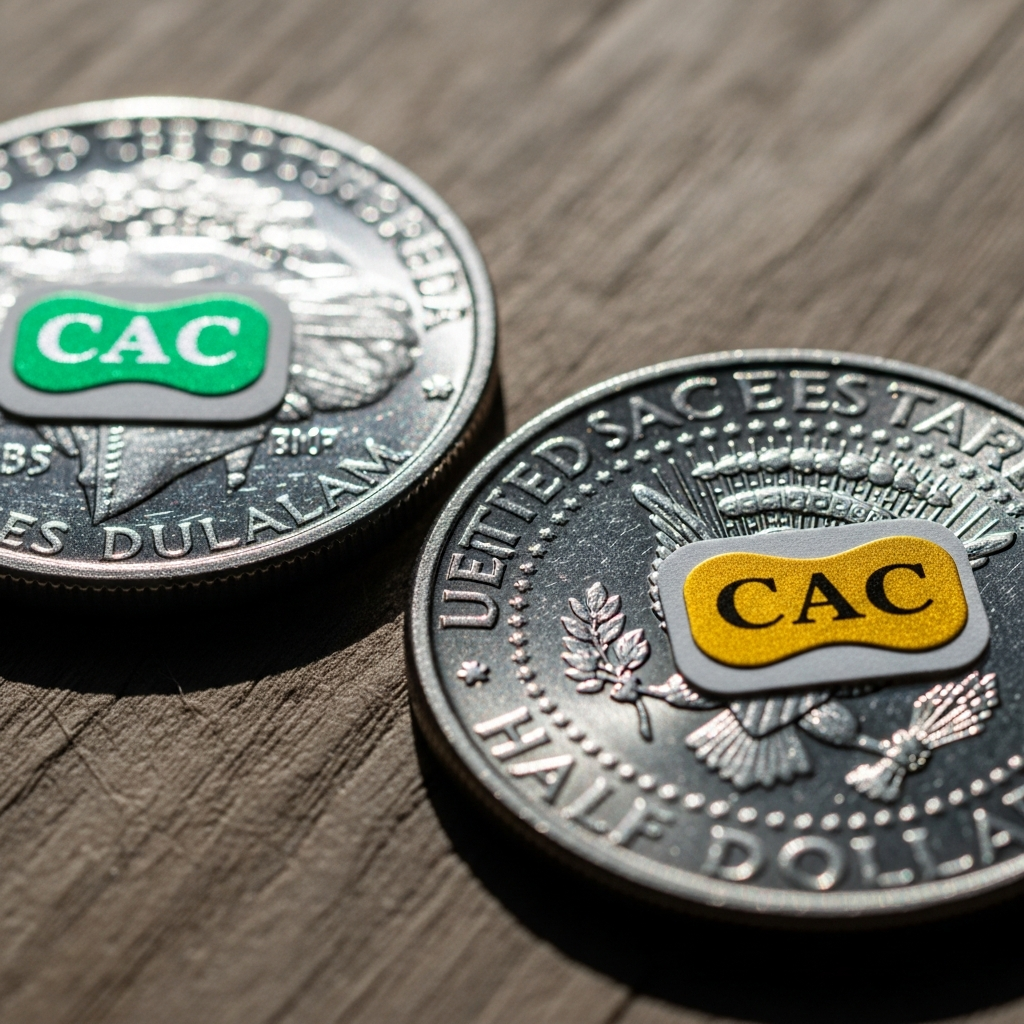
Green bean means the coin is solid for its assigned grade. Not a candidate for the next grade up — just a genuinely good, above-average example of what that grade should look like on its best day. A green-bean coin passed a second review by someone who does this professionally. That’s not nothing.
Gold bean is a different statement entirely. A gold sticker means the reviewer believes the coin is undergraded — that it belongs in the next grade up, not the one printed on the holder. An MS64 PCGS coin with a gold CAC bean is, in CAC’s judgment, MS65 quality sitting in the wrong slab. The holder still reads 64. The sticker is disagreeing with it, quietly but clearly.
Gold beans are genuinely rare. Far fewer coins earn them than green ones, and the market prices that scarcity in — gold-bean coins routinely trade at premiums that approach or match the next grade entirely. Don’t mistake one for the other at a show.
There’s also a third outcome nobody talks about enough: rejection. CAC sends plenty of coins back without any sticker. A coin known to have been submitted — you can often tell from context or the seller’s disclosure — that came back bare is a negative signal. Not neutral. The absence of approval carries information, and experienced buyers read it that way.
How Much More Is a CAC Coin Worth?
Let’s get specific. Vague talk about “premiums” doesn’t help when you’re at an auction lot with twenty seconds to decide how high to bid.
The honest answer is that premiums vary — by series, date, grade, and market conditions. But certain patterns show up consistently enough in auction records to be useful.
Common Date Morgan Dollars
Take something like an 1884-O Morgan in MS64. Without CAC, these trade in a tight range — maybe $85 to $120 at major auction because supply is deep. The same coin with a green bean typically brings $130 to $160. That’s a 20 to 40% bump for a coin that costs $30 to submit. The math works. Don’t make my mistake of dismissing that spread as noise.
Key Dates and Scarcer Issues
Premiums get dramatic on key dates. A 1921 Peace Dollar in MS64 — notoriously weakly struck as a series — with a green CAC bean sold at Stack’s Bowers in 2022 for $1,080, against a non-CAC MS64 average closer to $720. The sticker added roughly $360 on a $30 submission. That is not a rounding error.
Gold Coins
Pre-1933 US gold is probably where CAC stickers matter most — eye appeal swings wildly within grades on these, and bidders know it. A $20 Saint-Gaudens in MS63 with a gold bean regularly trades above the PCGS price guide value for MS64 examples outright. Heritage and Stack’s Bowers realized prices show the same pattern again and again: bidders treat gold-bean coins as one grade higher, because that’s exactly what CAC is telling them.
When CAC Adds Little Value
Not every coin benefits — worth being honest about that. Modern bullion coins, common silver in lower circulated grades, standard proof sets — minimal CAC premium on any of them. The grading spread within those grades is already tight, or the collector base driving competitive bidding just isn’t there. Submitting a VF35 Peace Dollar to CAC is almost certainly a $30 lesson in what not to do.
Should You Submit Your Coins to CAC?
Frustrated by what I thought was an obvious gold-bean candidate — a PCGS MS64 1924 Peace Dollar I’d convinced myself was undergraded — I submitted it through caccoin.com and got it back bare. No sticker. $30 gone, ego bruised. That experience recalibrated my self-assessment process considerably.
Current standard submission fee is $30 per coin on pieces valued under $10,000, with turnaround running several weeks through the online portal. The math is genuinely simple: if the sticker adds less than $30 to what you realize at sale, you lost money. That’s the entire calculation.
Coins Worth Submitting
- Already-graded MS64 and MS65 examples in series with wide quality spreads — Morgan dollars, Peace dollars, Walking Liberty halves, early US gold
- Coins where you genuinely believe the grade is light and a gold sticker is actually plausible, not just hopeful
- Key dates or conditionally rare coins where even a green bean realistically adds $100 or more at auction
- Coins headed to major auction — CAC-stickered lots draw more attention from the bidders with real money
Coins Not Worth Submitting
- Coins graded below MS63 or EF45 in most series — the premium rarely clears the fee
- Common coins in mid-range grades where weak and strong examples look nearly identical
- Coins you plan to hold indefinitely — the sticker’s value shows up at the sale, not on your shelf
- Coins where your honest read is that the current grade is already generous
A Note on Buying CAC Coins
Submitting your own coins is one question. Paying someone else’s CAC premium is another. My general approach: green beans justify a modest bump — maybe 15 to 20% on typical issues — because the second opinion is legitimately useful. Gold beans I evaluate as though they’re the next grade up and price accordingly.
What I won’t do is pay a full gold-bean premium without looking at the coin myself first. CAC gets it right most of the time. Not every time. The sticker is a credible signal — it is not a guarantee, and treating it like one is how you consistently overpay at auction.
The collector community’s focus on CAC beans isn’t irrational. It’s a direct response to a real, documented problem with how grades work in practice — and CAC provides a market-tested, credentialed answer to that problem. Understanding what the colors mean, what the actual dollar premiums look like, and when the submission math actually works in your favor is the difference between using CAC as a smart tool and either ignoring it entirely or outsourcing your judgment to a sticker.
Look at the coin first. Always. Then look at the bean.



Stay in the loop
Get the latest numisma news updates delivered to your inbox.