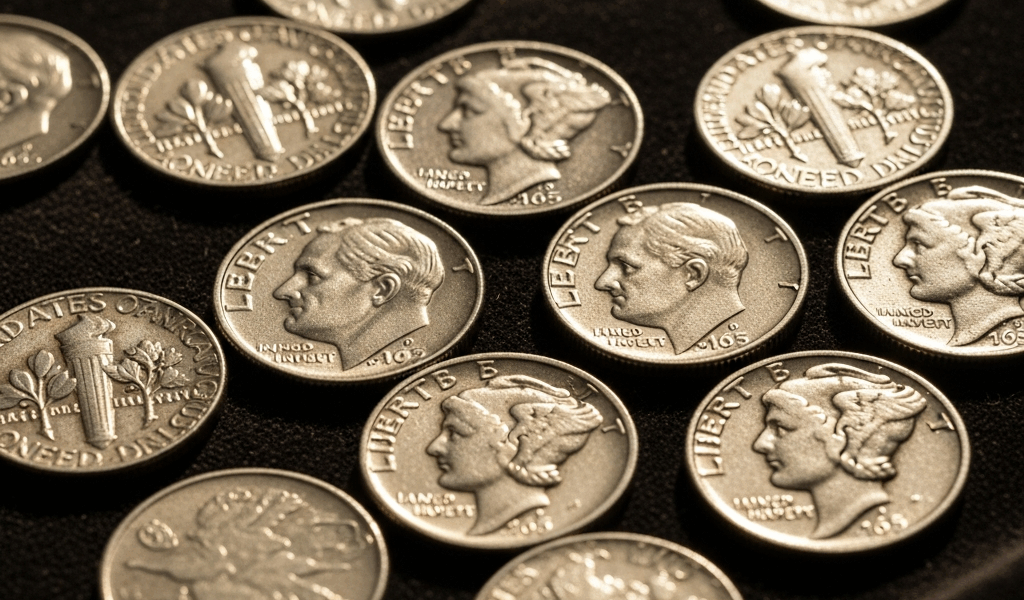
You picked up a Morgan silver dollar at an estate sale or inherited a small collection. The coin is heavy — 0.7734 troy ounces of silver — and the design is striking: Liberty on the front, an eagle spreading its wings on the back. Now you want to know what you have. Here is what matters when collecting Morgan dollars: mint marks, key dates, and the one thing new collectors need to avoid.
Morgan Silver Dollar Basics
Morgan silver dollars were minted from 1878 to 1904 and again in 1921. Designed by George T. Morgan, composed of 90% silver and 10% copper. The series spans 28 years across five mints — Philadelphia, New Orleans, San Francisco, Carson City, and Denver — creating 96 major date and mint mark varieties. That variety is what makes Morgans one of the most actively collected US coin series. There is always another date to pursue, another mint mark to find, another grade to upgrade.
Understanding Morgan Dollar Mint Marks
The mint mark sits on the reverse, below the wreath and above the D-O in DOLLAR. O for New Orleans. S for San Francisco. CC for Carson City. D for Denver, but only in 1921. Philadelphia coins carry no mint mark.
Why mint marks matter: Carson City coins were generally struck in smaller quantities and are the most prized by collectors. Any Morgan with a CC mint mark carries collector interest regardless of the date. New Orleans coins often show softer strikes due to aging equipment at that mint. San Francisco coins tend to be well-struck but have limited key dates. Philadelphia has the largest total mintages but includes the famous 1895-P proof-only issue — arguably the most valuable Morgan dollar in the entire series.
The Morgan Dollar Key Dates
The key dates that serious collectors pursue:
1893-S. The most famous Morgan dollar. Mintage of only 100,000 in a year when other mints struck millions. In VF condition: $5,000 to $10,000. In MS-65: over $500,000. This is the coin that separates casual collectors from committed ones.
1889-CC. Carson City, mintage 350,000. In circulated grades: $1,000 to $3,000. The CC mint mark on an 1889 consistently brings strong auction results.
1895-P. If it exists in circulation-strike form, only a handful are known. The proof 1895 is the key of the entire series in proof condition. Approaching this coin requires deep pockets and patience.
Semi-key dates worth knowing: 1879-CC, 1885-CC, 1886-O, 1892-S. These cost $100 to $500 in circulated grades but are legitimately scarce and form the backbone of an advanced Morgan collection.
For new collectors: building a set of common-date Morgans is affordable — many dates are available for $30 to $50 in VF condition. Pursuing the key dates requires significant investment and authentication through PCGS or NGC.
How to Grade Morgan Dollars
The PCGS and NGC grading scale runs 1 to 70. For the collector, the practical grades to understand:
VF-20 to VF-35 (Very Fine): Clear design details with heavy circulation wear visible on Liberty’s hair and the eagle’s breast feathers. An honest, handled coin with character.
AU-50 to AU-58 (About Uncirculated): Slight wear on the highest points only. Most original luster remaining. These often represent the best value for collectors — near-mint condition without the mint-state price premium.
MS-60 to MS-63: Uncirculated but with bag marks from storage in canvas mint bags. Many Morgan dollars survived in bank vaults for decades, emerging uncirculated but with contact marks from bumping against other coins.
Beyond the certified grade, the eye appeal factors that matter: luster quality (the cartwheel effect when you rotate the coin under light), strike sharpness (especially on Liberty’s hair above the ear), and color. Original toning — rainbow or uniform silver-gray — adds appeal. Artificial toning, usually applied with chemicals to simulate age, reduces it.
Cleaned Coins: What New Collectors Must Know
Cleaned Morgan dollars are the most common quality problem in the collector market. Cleaning destroys the original surface texture — the microscopic flow lines from the minting process that create luster. A cleaned Morgan shows a bright, shiny surface that looks attractive in a photograph but lacks the rotational cartwheel luster of an original uncleaned coin.
How to spot cleaning: hairlines (fine parallel scratches from polishing cloths), unnatural brightness with no directional luster, and stripped color in the high-relief areas where the polishing cloth made heaviest contact.
Why it matters financially: a cleaned 1882-S Morgan that would grade MS-63 original is worth approximately $150. The same date cleaned and graded “Details (Cleaned)” by PCGS or NGC is worth $30 to $40. Cleaning destroyed $100 of value on a common date. On a key date, the damage is proportionally larger.
Two rules for new collectors: never clean a Morgan dollar, and never buy a Morgan from a casual seller without PCGS or NGC certification. Cleaning is often invisible to the untrained eye in photographs. Let the grading services protect you.


Stay in the loop
Get the latest numisma news updates delivered to your inbox.