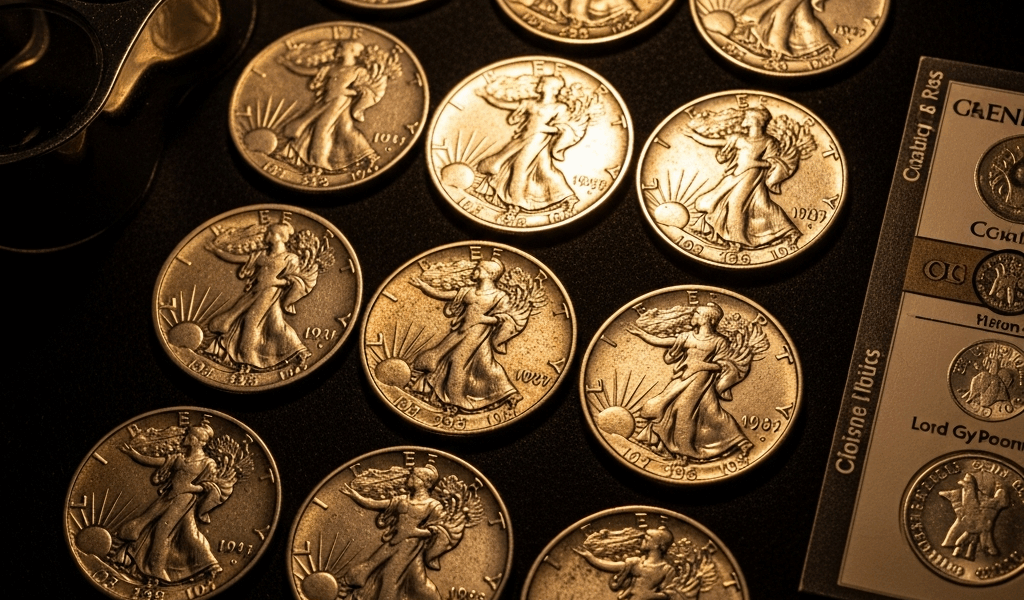
What Makes a Walking Liberty Half Dollar Worth Looking Up
This article includes affiliate links. We may earn a commission at no extra cost to you.
Walking Liberty half dollars have gotten complicated with all the misinformation flying around — especially now that silver prices keep climbing and everyone’s suddenly a coin expert. I found one in my grandfather’s desk drawer last year and spent about three hours down a rabbit hole trying to figure out if it was worth anything. Spoiler: most aren’t. But some absolutely are.
The series ran from 1916 to 1947. Each coin is 90% silver, 10% copper — a composition that alone makes every single one worth tracking down right now. But here’s what most online price guides quietly skip over: date and condition matter more than people expect. A 1916-D in the right grade can move for $1,200. A common 1941 in the same grade? Fourteen bucks. That gap is enormous.
Probably should have opened with this section, honestly. Most people inherit these coins or buy bulk estate lots without any real idea which ones deserve a closer look. That’s exactly what this breakdown is for. You’re not a dealer. You’re holding a coin and wondering whether it’s silver scrap or something worth the hassle of professional grading. Those are two very different situations.
Three things determine the answer: the date, the mint mark — a tiny letter stamped to show where it was struck — and how worn it actually is. A key date in excellent shape can beat melt value by 10x or more. A common date in circulated condition? That’s melt territory. Most Walking Liberties fall into that second camp. Accept it and move on. But if you’ve got one of the dates listed below, don’t skip the next section.
Key Dates and Mint Marks That Command Real Premiums
Pulled straight from auction records and dealer price lists, these are the dates that actually generate collector interest and real premium value. Each entry includes realistic price ranges for two practical grades: VG (Very Good) and VF (Very Fine). These are the grades most people actually encounter in old collections and estate sales — not the fantasy grades sellers post on eBay.
1916 and 1916-D — The Outliers
The 1916 is a lower-mintage year across the board. The 1916-D, struck in Denver, carries an unusual detail — its mint mark appears on the obverse side of the coin, not the reverse like later dates. Collectors specifically hunt this variant. A 1916-D in VG-8 runs $180–$250. In VF-20, expect $350–$500. The regular 1916 — no mint mark, Philadelphia — sits lower: $85–$140 in VG, $160–$240 in VF.
1916-S — San Francisco’s Scarcity
Lower production volume out of San Francisco in 1916 means S-mint coins show up less often than you’d think. A 1916-S in VG-8 typically trades at $120–$180. VF-20 examples move at $220–$350. Not headline-grabbing numbers, but they beat melt value by a comfortable margin — and that’s the whole game here.
1917-D Obverse — Another Mint Mark Hunt
Like the 1916-D, the 1917-D obverse mint mark catches collector attention fast. VG-8 pricing: $160–$240. VF-20: $300–$450. Worth noting — the 1917-D reverse, with the mint mark on the back, is far more common and worth significantly less. Make sure you’re looking at the right side before getting excited.
1919-D and 1921-D — Medium-Tier Premiums
Neither of these dates was minted in huge quantities, and the D-mint versions draw real attention from serious collectors. A 1919-D in VG ranges $65–$110; in VF, $140–$210. The 1921-D sits at $75–$130 in VG and $160–$250 in VF. Not crown-jewel territory, but well worth pulling from the junk bin.
1921 and 1921-P — The Crown Jewels
The 1921 Philadelphia mint — no mark — is genuinely scarce. Low mintage in an otherwise steady series. That’s what makes the 1921 endearing to us collectors. A 1921 in VG-8 commands $80–$140. In VF-20, you’re looking at $180–$300. Serious buyers notice this date immediately — sometimes before you’ve finished describing it.
I’ve seen 1921 halves wildly overpriced on eBay — sellers caught the “rare date” energy but never checked actual sold listings. Don’t make my mistake. The ranges above reflect realistic dealer and auction outcomes from the past 18 months, not wishful thinking.
Quick Reference Table
| Date & Mint Mark | VG-8 Range | VF-20 Range |
|---|---|---|
| 1916 | $85–$140 | $160–$240 |
| 1916-D | $180–$250 | $350–$500 |
| 1916-S | $120–$180 | $220–$350 |
| 1917-D (Obv) | $160–$240 | $300–$450 |
| 1919-D | $65–$110 | $140–$210 |
| 1921 | $80–$140 | $180–$300 |
| 1921-D | $75–$130 | $160–$250 |
How Condition Affects Walking Liberty Values
Condition is the volume knob on Walking Liberty values. The spread between Good and Mint State can be 10x the price — sometimes more. It’s not subtle.
The high points of Lady Liberty’s design wear first. Her hand holding the olive branch, her face, the eagle’s wing tips — those surfaces go flat long before the rest of the coin looks rough. Professional graders check those spots immediately. Worn smooth means circulated territory: G, VG, or VF. Still sharp? That coin probably sat in a collection since 1950 and grades considerably higher.
G-4 (Good)
Heavily worn. You can read the date and spot the mint mark, but Liberty’s features are flat. Her face is nearly gone. A typical 1941 in G-4 brings about $9–$12 — barely above melt. Even key dates don’t move much at this grade. Skip the grading fees entirely. Calculate melt value — roughly $9.50 per coin at current silver spot — and move on.
VG-8 (Very Good)
Moderate wear. Liberty’s outline is clear. Her hand and face show some actual detail. Date and mint mark are sharp. This is the threshold where key dates start pulling real premiums, as the table above shows. A 1921 in VG-8 at $80–$140 is worth handling properly — whether you sell it raw or submit it for grading.
VF-20 (Very Fine)
Light wear on the high points. Liberty’s face shows good definition. Her hand and the eagle’s wings retain most of their detail. This is the sweet spot for collector interest. A common 1938 in VF-20 fetches $16–$22. A 1921 in VF-20 jumps to $180–$300. That jump is real — and it matters for how you handle the coin next.
EF-40 (Extremely Fine)
Minimal wear. Fine detail visible in Liberty’s hair and drapery. Eagle’s feathers are crisp. These turn up occasionally in old hoards and carefully stored collections. A 1941 in EF-40 is worth $30–$45. A 1921 in EF-40 hits $400–$600. At this grade, professional grading makes financial sense.
MS-63 (Mint State)
Never circulated. Luster fully intact. Minor bag marks only. These are genuinely rare for Walking Liberties — most were spent or damaged during the 1950s and 1960s. A common 1941 in MS-63 brings $50–$75, a real jump from VF pricing. Key dates in MS-63 pull $1,000 and up. A 1921 in MS-63 can hit $2,000–$3,500 depending on eye appeal and provenance.
The lesson I learned the hard way: never assume a Walking Liberty in “pretty good” condition is slab-ready. Get it in hand. Look at Liberty’s face under a loupe — I use a 10x Bausch & Lomb — and check for flatness. Any soft detail puts it at VF or below. That’s not bad news. It just changes your next move.
How to Tell If Your Half Is Worth Grading or Selling Raw
Professional grading runs $20–$30 per coin if you submit five or more at once through PCGS or NGC. Shipping and insurance add another $5–$10 on top of that. So before you box anything up, you need to know whether the return actually justifies the cost.
Grade It If
- It’s a key date — 1916-D, 1921, 1917-D obverse — in VF or better condition.
- It grades Extremely Fine or Mint State regardless of the date.
- You pulled it from an estate with no provenance history. A slab adds buyer confidence and usually justifies a higher ask.
Sell It Raw If
- It’s a common date — anything from the 1930s or 1940s — in circulated condition. Grading fees eat your profit.
- It’s visibly worn. VG or lower doesn’t cover slab costs.
- You need quick cash. Raw coins move faster on eBay and with local dealers — no waiting three weeks for a return package.
The Melt Value Floor
Every Walking Liberty contains 0.3617 troy ounces of silver. At $28 per troy ounce — a recent spot price — that’s about $10.14 in pure silver content. Dealers typically pay $10.50–$11.50 per coin for raw Walking Liberties with no numismatic premium attached. If your coin is a common date in average shape, that’s your realistic exit price. Don’t wait on grading results or hope for an eBay bidding war. You’ve already got your answer.
Where Collectors Buy and Sell Walking Liberty Halves
PCGS CoinFacts might be the best starting point, as Walking Liberty research requires solid auction data. That is because they track realized prices, population numbers — how many coins graded at each level — and rarity rankings for every date and mint mark combination. It’s the single most reliable resource for understanding fair market value on key dates.
Heritage Auctions publishes realized prices for raw and graded Walking Liberties every week. Their catalog archives let you see what serious collectors actually paid for specific dates in specific grades. This beats guessing every single time — and it’s free to search.
eBay completed sales are your raw-coin reference. Filter by “sold” listings, sort by most recent, and look at the last 10–15 sales of your exact date and estimated grade. Real market data from real collectors and dealers. I’m apparently stubborn about this step, and checking eBay comps works for me while skipping it never does. Don’t make my mistake — I sold a 1916-S to a pawn shop once and left $40 on the table.
Local coin dealers will buy raw Walking Liberties for melt value plus a small markup, usually same-day. Convenient, but not the highest price you’ll get. Reputable dealers honor current silver spot prices — if they lowball you, walk out. The best approach: pull PCGS CoinFacts data on your date, check eBay comps, then use both to negotiate with a local dealer or list privately online. That sequence rarely fails.


Stay in the loop
Get the latest numisma news updates delivered to your inbox.