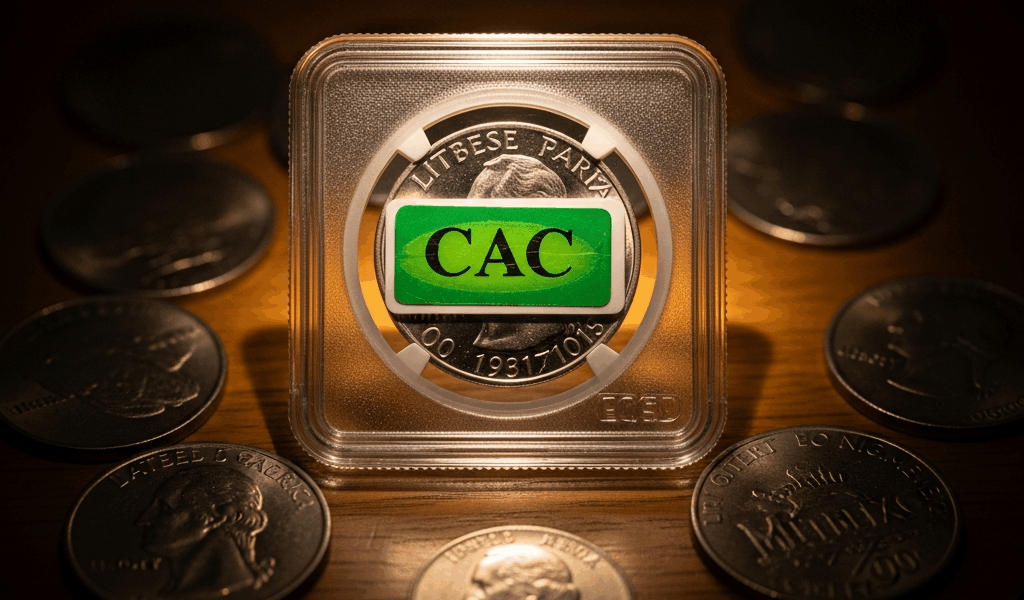
CAC Stickers Have Gotten Complicated With All the Misinformation Flying Around
As someone who spent months watching auction results and pestering dealers at coin shows, I learned everything there is to know about CAC verification. Today, I will share it all with you.
The first time I spotted a CAC sticker on a coin listing, I genuinely had no clue what I was looking at. Green label, looked official, price was noticeably higher than identical coins sitting right next to it. My first instinct was that it was some kind of dealer markup trick. It wasn’t. After enough auctions and enough conversations with people who actually knew things, I figured out what was really going on — and why that tiny sticker moves serious money.
What CAC Actually Does
But what is CAC? In essence, it’s a second-opinion grading service for coins that have already been certified. But it’s much more than that.
CAC stands for Certified Acceptance Corporation. Here’s the short version: they review coins that PCGS (Professional Coin Grading Service) and NGC (Numismatic Guaranty Company) have already graded and sealed inside holders. CAC doesn’t start from scratch. They look at the coin through its existing slab and decide whether the assigned grade is accurate, too generous, or actually conservative.
Think quality assurance. PCGS and NGC are genuinely excellent — but they’re grading thousands of coins every single day. Errors creep in. CAC catches some of those errors. Or, just as usefully, they confirm that a coin earned its grade fair and square.
Two sticker colors. That’s the whole system.
- Green sticker: The coin meets or exceeds the standards for its grade. Solid. Not overgraded, not undergraded. Just right.
- Gold sticker: CAC believes the coin is actually undergraded — that PCGS or NGC was too conservative. It probably deserves a higher number than what’s printed on the label.
No red sticker exists. No public rejection list. If CAC passes on a coin, it comes back to you in the same holder it arrived in — no label, no explanation, no announcement. Just silence. Savvy buyers notice that silence, though. Don’t think they don’t.
Frustrated by what he saw as inconsistent grading standards across the industry, John Albanese founded CAC in 2007 using criteria developed from decades of hands-on numismatic experience. This new credibility-focused approach took off within a few years and eventually evolved into the verification standard serious collectors know and rely on today. Albanese had already co-founded PCGS back in 1986 — the man knows grading. That history matters.
How CAC Evaluates a Coin
CAC doesn’t publish a thick grading manual — there’s no 500-page rulebook you can download. What they do look at: eye appeal, strike quality, luster, color (especially on copper and early American issues), and overall quality relative to whatever grade is already on the holder. A coin that’s been cleaned, even lightly, almost never gets a sticker. Surface problems that don’t match the assigned grade get noticed fast.
I once submitted a PCGS MS-64 Morgan dollar — 1884-O, decent luster, what I thought were acceptable bag marks for the grade. CAC rejected it. No sticker came back. Looking at it again afterward, those marks were more prominent than I’d been willing to admit to myself. That rejection stung, but honestly? Valuable feedback. Free, almost, compared to what I might have lost selling it as a premium coin.
CAC also watches market behavior. If PCGS grades something MS-65 but the market has consistently hammered that designation because PCGS is known to run generous on that particular series, CAC might decline to validate it. They’re protecting their own reputation — and incidentally, yours.
The Premium — Real Numbers
This is where things get economically interesting. CAC-verified coins sell for measurably more. That’s not opinion. That’s auction data.
Green Sticker Premiums
A green sticker typically adds 10 to 20 percent to a coin’s realized value. Sometimes more. I watched a PCGS MS-64 Morgan dollar without CAC sell for $850 at a Heritage auction. Same date, same mint mark, same MS-64 grade — but with a green CAC sticker on the holder? $1,050. That’s a 24 percent premium, and the only variable was the sticker.
Scarcer dates amplify the effect. A PCGS AU-58 Standing Liberty quarter without CAC might bring $2,200. With green CAC? $2,700 or higher. Rarity makes buyers even more nervous about grade accuracy — and more willing to pay for reassurance.
Gold Sticker Premiums
Gold stickers are a different animal entirely. A gold CAC sticker means professional graders think PCGS or NGC was actually too conservative — the coin might legitimately deserve a higher grade number. Premiums run 25 to 50 percent. Sometimes beyond that.
An MS-63 Morgan dollar with a gold sticker fetched $1,200 at auction. Three months earlier, the same date and mint in MS-63 — no sticker — had sold for $775. That’s a 55 percent jump. The sticker was, as far as anyone could tell, the only meaningful variable.
Gold stickers are rare. CAC doesn’t hand them out freely. When one shows up, collectors and dealers recognize it immediately — the coin isn’t just solid for its grade, it’s actually worth more than the label suggests. That’s what makes gold stickers so endearing to us collectors.
Grade Level Changes Everything
The premium isn’t uniform across grades. A green CAC sticker on an MS-67 coin adds less in percentage terms than a green sticker on an MS-60. Higher-grade coins already carry premiums — the relative CAC benefit shrinks percentage-wise, even if the dollar figure stays substantial.
Circulated material is a different story. A VF-30 with a green sticker might see a 5 to 10 percent bump — maybe $20 to $40 on a $400 coin. Buyers of circulated coins tend to care more about date rarity and mint mark than grading precision. CAC matters less at the low end of the scale.
Should You Submit Your Coins to CAC
Probably should have opened with this section, honestly. Most newer collectors ask this before they understand what CAC even is. So, without further ado, let’s dive in — because the answer is more specific than most people expect.
What It Costs
CAC charges per coin. Standard service — roughly 10-business-day turnaround — runs about $20 to $25 per coin for standard-size submissions. Expedited service costs more. Submit 10 coins and you’re looking at $200 to $250 in fees before shipping even enters the picture.
Fees have climbed. Worth knowing. When CAC first opened stickering services widely, submissions ran closer to $10 per coin. Demand and inflation pushed that up. Don’t make my mistake of budgeting based on old forum posts from 2012.
Which Coins Are Worth Submitting
Only PCGS or NGC holders qualify — at least if you want any shot at a sticker. CAC doesn’t work with coins graded by smaller services. You need the major-label slab first.
Second filter: is the coin valuable enough? A $150 coin in a PCGS holder doesn’t justify $25 in CAC fees. You’d need a 20 percent premium just to recover the submission cost — and that’s not guaranteed on a low-value coin. The math only works when the numbers are big enough.
Strong candidates for submission:
- High-grade coins — MS-65 and above, or proof equivalents. Premiums at those grades justify the fee without much question.
- Key dates and scarce varieties. Rarity amplifies buyer confidence, which amplifies the premium.
- Coins you suspect might be undergraded. If you’re right, the gold sticker premium can be substantial.
- Coins you’re planning to sell within the next year. The liquidity advantage is real, but it fades if you’re holding for decades.
Modern vs. Classic Coins
Modern coins graded MS-67 and higher can benefit from CAC — a 2021 American Silver Eagle MS-69 with a green sticker does carry more buyer confidence than an identical coin without one. But modern bullion doesn’t see the same premium levels that classic material does. The dollar benefit is smaller.
Classic coins are a different matter entirely. Morgan dollars, Peace dollars, Saint-Gaudens double eagles, Barber coinage — these are actively collected series where grading precision actually moves the needle. Buyers pay for that assurance. CAC might be the best option here, as classic coin collecting requires confident grade validation. That is because the price spread between adjacent grades can be enormous — the difference between MS-64 and MS-65 on a key-date Morgan isn’t $50. It’s potentially $1,500.
Submit your classic coins. Think twice before submitting modern material.
When CAC Pays for Itself
While you won’t need a finance degree to run this math, you will need a handful of realistic numbers. Your coin needs to gain at least $25 in realized value after receiving a sticker for the fee to break even. That’s the floor.
A $3,000 coin that gains 15 percent from a green CAC sticker jumps to $3,450. You paid $25. You gained $450. That’s an easy calculation. For coins under $500, CAC only makes sense if you’re genuinely confident the coin is undergraded — or if it’s valuable enough that the liquidity boost alone justifies the cost.
CAC vs. No CAC — Does It Actually Matter for Your Collection
The honest answer depends on what you’re actually doing with the coins.
Collecting for Personal Enjoyment
First, you should ask yourself why you’re buying coins — at least if you want to make a rational decision about CAC. If the answer is that you love coins, that you’re building a collection for the pleasure of it, CAC verification probably doesn’t matter much. You’re not selling. You don’t need to prove anything to a future buyer. A green sticker is a nice thing to have, but it doesn’t change what the coin looks like under a lamp or what it means historically.
Plenty of serious collectors — people with decades of experience and incredible holdings — never bother with CAC at all. They trust their own eye. They buy what they like. No stickers required.
Collecting for Investment
Buying coins with the intention to sell for profit changes the calculation entirely. CAC verification removes uncertainty from a future buyer’s mind. It provides a credible second opinion. It makes your coin easier to liquidate — and easier to liquidate at a higher price.
Investment-focused collectors should prefer CAC-verified coins when buying. They should consider submitting their best pieces before selling. The sticker is a confidence signal in the secondary market. That signal has measurable dollar value.
Selling Your Coins
I’m apparently someone who learns things the slow way, and submitting before selling works for me while skipping that step never does.
Last year I sold a group of 15 Morgan dollars. I submitted five of the best — including an 1893-S PCGS VF-25 and an 1895-O PCGS MS-62 — to CAC before listing anything. All five came back with green stickers. Those five coins averaged 18 percent above comparable unstickered examples at auction. The other ten, which I didn’t submit? Lower premiums, more negotiation, slower sales. The $125 I spent on CAC fees came back many times over.
That experience changed how I think about it. CAC isn’t really a collector tool — it’s a liquidity and valuation tool for anyone moving coins in the secondary market. If you’re planning to sell, it’s worth the investment.
Building Long-Term Holdings
Holding coins for 10 or 20 years changes the math on submission fees. The cost is real but the benefit gets diffuse over time. Still — when you eventually do sell, CAC-verified coins are easier to move. Faster transactions, less negotiation, more confident buyers. You’re essentially buying convenience for your future self.
One thing remains constant regardless of timeline: CAC-verified coins sell faster and with less friction. For anything destined for the market eventually, that’s genuinely valuable. That’s what makes CAC so endearing to us serious collectors.



Stay in the loop
Get the latest numisma news updates delivered to your inbox.