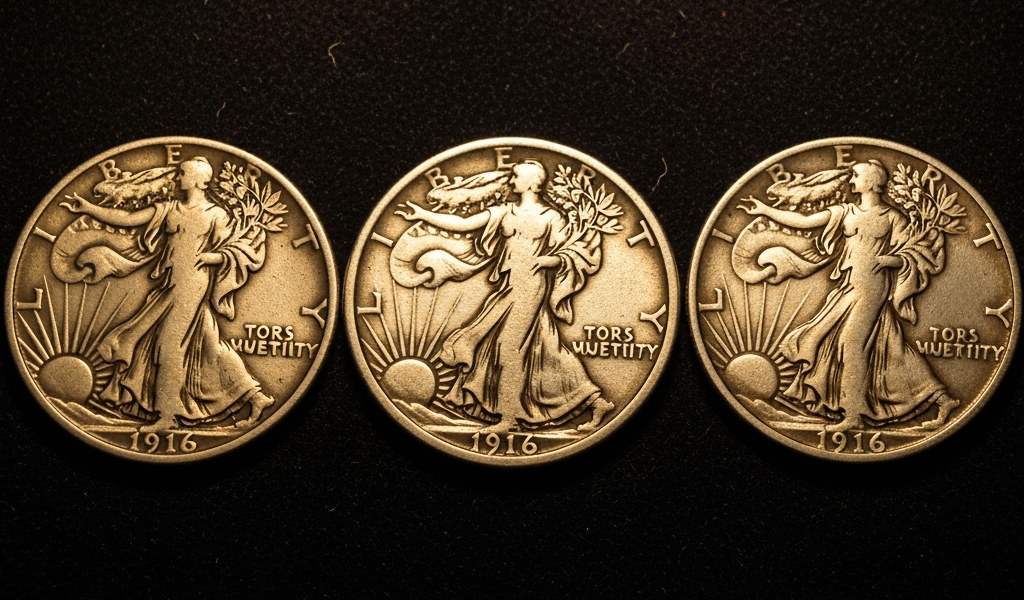
Why the 1916 Standing Liberty Quarter Is So Valuable
Standing Liberty Quarter research has gotten complicated with all the misinformation flying around — especially when you’re trying to nail down actual values by variety. As someone who inherited a circulated 1916 example from my grandfather’s collection, I learned everything there is to know about this coin the hard way. Today, I will share it all with you.
The price range shocked me when I first dug in. Most collectors assume early quarters from this era cluster in the same ballpark. They really don’t. The 1916 is the inaugural year of the Standing Liberty design — Philadelphia-minted, 52,000 coins total. That’s it. For comparison, the US Mint struck over 3 billion dimes in 2020 alone. Fifty-two thousand coins spread across a nation of 100 million people meant very few survived in any real condition.
But what is the 1916 Standing Liberty Quarter’s true draw? In essence, it’s a scarce first-year coin. But it’s much more than that. The Type 1 design — Liberty with an exposed breast on the obverse — is what collectors actually chase. The Mint fielded complaints about the design and changed it mid-series. Every single 1916 quarter ever struck carries that Type 1 design. That distinction matters enormously for authentication and for price.
A heavily circulated 1916 still fetches $700–$1,200. A fine specimen can command $5,000 or more. Mint state examples breach five figures regularly. Compare that against a 1916 Barber quarter — same date, $50–$150 circulated. The Standing Liberty series holds collector demand that Barber coins simply never achieved. That’s what makes this coin endearing to us collectors.
Type 1 vs Type 2 — How to Tell Them Apart
Probably should have opened with this section, honestly. This is where most of my early confusion lived.
The difference is on Liberty’s torso. Look at the obverse — upper left, where her chest meets the shield. On Type 1 coins (every 1916 quarter, no exceptions), Liberty’s breast is exposed and clearly defined. A nipple is visible under 10x magnification. The shield sits lower. Her drapery begins well below the shoulder.
Type 2 quarters, struck from late 1917 forward, show Liberty fully draped. Covered chest, higher shield, no exposed breast. The design element that drew public objection was removed entirely.
Here’s what matters for your 1916: every genuine 1916 Standing Liberty Quarter is Type 1. Full stop. If someone offers you a 1916 “Type 2,” it’s either misidentified — probably a 1917 or later date — or it’s a counterfeit. This confusion drives a surprising number of searches, so I’m flagging it directly.
To separate a 1916 from a 1917 quickly, start with the date itself. The 1916 numerals sit at a marginally different angle than the 1917 font. Worn examples make this harder to see, but under decent light with 10x magnification, the “6” in particular gives it away. The shield design is identical on both Type 1 coins — 1916 and early 1917 — so leaning on shield details alone won’t get you there. Date plus breast detail together confirm what you’re holding.
1916 Standing Liberty Quarter Value by Grade
Grade is everything here. Moving from AG-3 to F-12 isn’t a minor bump — it’s a value multiplication. So, without further ado, let’s dive in.
Based on PCGS and NGC auction results over the past three years, here’s what 1916 Standing Liberty Quarters actually trade for:
- AG-3 (About Good): $750–$950. The date reads but details are worn smooth. Liberty’s face is barely a suggestion.
- G-6 (Good): $900–$1,200. Outlines hold up. High points are flat. Shield shows some definition.
- VG-8 (Very Good): $1,300–$1,800. Design elements are legible throughout. Liberty’s face shows actual character lines.
- F-12 (Fine): $4,000–$6,500. Details sharp across the board. This is where most serious collectors enter the market.
- VF-20 (Very Fine): $7,500–$11,000. High points carry only light wear. The reverse eagle is nearly full.
- VF-35 (Choice Very Fine): $13,000–$18,000. Minimal wear overall. Nearly uncirculated eye appeal.
- XF-40 (Extremely Fine): $18,000–$26,000. Wear only visible under magnification. Strong luster remains.
- AU-50 (About Uncirculated): $28,000–$40,000. Highest points show slight wear only. Original mint shine intact.
- MS-60 (Mint State, Bagmarks): $45,000–$65,000. No wear at all — but contact marks from storage.
- MS-63 (Mint State, Select): $70,000–$95,000. Light marks, attractive strike throughout.
- MS-65 (Gem Mint State): $110,000–$160,000. Minimal marks, exceptional eye appeal.
The jump from F-12 to VF-20 is severe — scarcity accelerating sharply as preservation quality rises. Mint state is rarefied air. PCGS has certified roughly 120 examples in MS-60 or better across all Standing Liberty Quarter dates and varieties combined, including later, more common issues.
One detail that matters immensely: the Full Head designation — FH. A Standing Liberty Quarter with fully struck hair detail on Liberty’s head commands a 15–30% premium in mint state grades. Sounds minor. Collectors pay for it anyway. An MS-63 FH might trade at $95,000 while a standard MS-63 sits at $70,000. Don’t overlook it.
Known Fakes and What to Watch For
Altered-date coins are the primary threat in the 1916 market. The scam: take a more common 1917 Type 1 quarter and shave or re-engrave the date to read 1916. Financially, this makes no obvious sense — until you realize buyers unfamiliar with the series happily pay 1916 prices for what’s actually a 1917 coin.
How to spot an altered date: examine the numerals under 10x magnification and look for tool marks or uneven patina. A genuine date shows consistent color and wear across the numeral. A re-engraved “6” carries tool striations inside the digit. Where numerals meet the field on an original strike, edges are smooth and natural — on an altered coin, you’ll find rough spots or fills instead.
Weight and edge reeding both matter here. A genuine 1916 Standing Liberty Quarter weighs exactly 6.25 grams. If your example comes in at 6.1 grams or 6.4 grams, something is wrong. Count the reeds along the edge — 119 reeds on a genuine specimen. Counterfeits cast from molds frequently show 115–117 or 121–123 reeds.
The reverse shield is another checkpoint. On a genuine 1916, the shield’s vertical lines are crisp and evenly spaced. Counterfeits often show mushy or wavy lines — a symptom of a poorly made die or an overly soft planchet.
I’m apparently someone who learns things the hard way, and a raw 1916 I once handled taught me this lesson directly. Perfect surfaces in photos, sharp strike, great color. In hand, the weight was off by 0.08 grams and the reeding count came in at 116. It was a casting — probably from a Chinese mold based on the surface texture. Don’t make my mistake. Third-party grading matters not just for resale value but for your own peace of mind.
Should You Get It Graded Before Selling
While you won’t need to certify every coin in your collection, you will need a clear-eyed cost-benefit read on your specific example. First, you should honestly assess estimated value — at least if you want the grading fee to make financial sense.
If your 1916 is worth under $500 raw — likely AG or G grades — certification costs more than the premium you’ll recover. PCGS and NGC both charge $25–$35 per coin at standard turnaround. Skip it at that value level.
Above $500, grading becomes sensible. A raw VG-8 or F-12 sells at a 20–35% discount because dealers and private buyers automatically price in authentication risk. Getting it slabbed runs roughly $30 but recovers $400–$1,500 in perceived value depending on the grade. PCGS might be the best option, as the Standing Liberty series requires precise attribution. That is because Type 1 designation carries significant price implications that raw sales often obscure.
Cleaned examples are a hard sell regardless of grade. If your coin shows polishing, wire brushing, or chemical cleaning, disclose it openly. A cleaned F-12 might grade at F-10 or lower — and collectors actively avoid cleaned Standing Libertys. The original patina is part of what they’re buying.
Ship to PCGS or NGC via registered mail for any coin exceeding $1,000 in estimated value. Include detailed photos and a brief cover letter noting known provenance or damage. Standard turnaround runs 15–30 business days depending on which service tier you select — the $35 standard tier is usually sufficient unless you’re in a hurry to sell.


Stay in the loop
Get the latest numisma news updates delivered to your inbox.