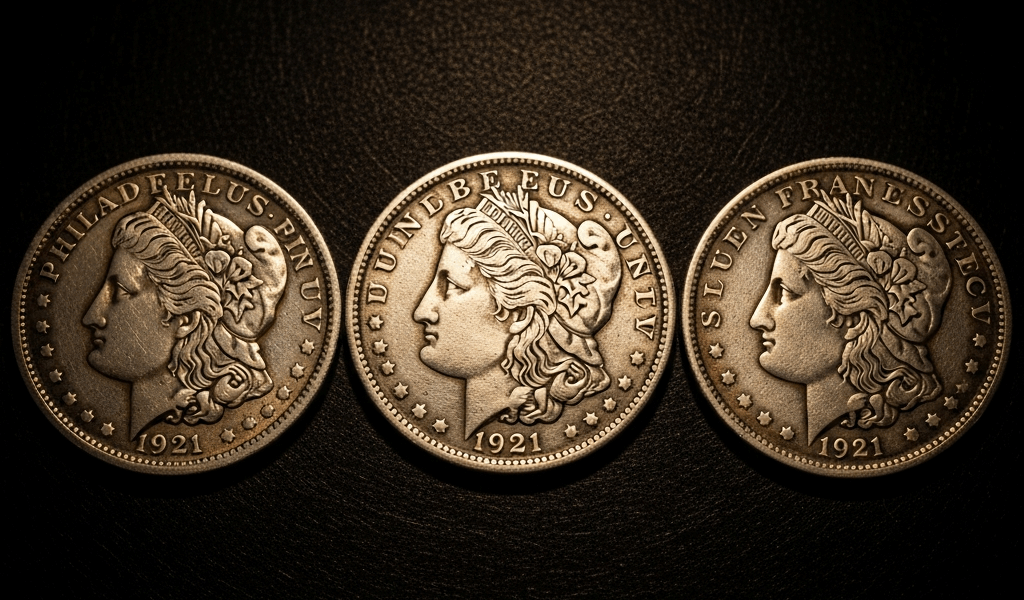
1921 Morgan Dollar Value and What Yours Is Worth
Morgan dollar pricing has gotten complicated with all the bad information flying around online. As someone who’s spent the last five years buying and selling at coin shows, I’ve learned everything there is to know about the 1921 Morgan specifically. Today, I’ll share it all with you.
The 1921 Morgan is the coin that lands on my desk most often. People inherit them. Find them in old jars. Pull them out of estate lots worth maybe $40 total. And almost every single person asks the same thing: “How much is this worth?” Honest answer — it depends on three things. Which mint struck it, how much wear it shows, and whether someone cleaned it. Nail those three details and you’ll know exactly where your coin sits, somewhere between $22 in circulated grades and $800 or more if you’re holding an uncirculated gem.
What Makes the 1921 Morgan Different From Other Dates
But what is the 1921 Morgan, exactly? In essence, it’s the final year of the entire Morgan dollar series. But it’s much more than that — it’s also the highest-mintage date in Morgan history, with over 86 million coins struck across three facilities: Philadelphia, Denver, and San Francisco combined.
Most of those 86 million coins went straight into circulation and stayed there. They paid for groceries. Bought gas. Got passed hand to hand until the details were barely visible. That’s why a truly uncirculated 1921 Morgan is genuinely hard to find — not because the original mintage was small, but because almost none survived without wear. The date carries no scarcity premium. The condition does. That’s what makes the 1921 endearing to us collectors, honestly — it punishes lazy grading and rewards anyone who actually knows what they’re looking at.
1921 Morgan Dollar Value by Mint Mark and Grade
Probably should have opened with this section, honestly. New collectors always assume mint marks create massive value swings on the 1921. They don’t — not dramatically anyway. But let’s back up. First, you should locate your mint mark — at least if you want an accurate valuation. Flip to the reverse, the eagle side, and look just below the wreath slightly left of center. You’ll see a “D” for Denver, an “S” for San Francisco, or nothing at all for Philadelphia. Philadelphia coins from this era sometimes carry no mark.
Here’s how values break down across grades and mint marks. These reflect approximate retail prices as of early 2024:
| Grade | 1921-P | 1921-D | 1921-S |
|---|---|---|---|
| Good-4 to Fine-12 | $22–$28 | $24–$30 | $26–$32 |
| VF-20 to XF-40 | $32–$55 | $35–$60 | $38–$65 |
| AU-50 to AU-58 | $65–$110 | $70–$125 | $75–$130 |
| MS-60 to MS-62 | $140–$180 | $160–$210 | $170–$225 |
| MS-63 to MS-64 | $220–$350 | $250–$400 | $280–$450 |
| MS-65 and above | $400–$800+ | $450–$900+ | $500–$1,000+ |
That jump between MS-62 and MS-63 is real and it’s steep. Below MS-60, you’re mostly paying for silver content plus a small numismatic bump. Above MS-63, you’re paying for condition and genuine eye appeal — which is where serious collectors actually compete. Denver and San Francisco coins carry modest premiums over Philadelphia in higher grades. Tighter original mintages relative to demand. Not dramatic, but consistent. I’m apparently someone who notices these things obsessively, and tracking those small mint-mark spreads over five years of transactions works for me while ignoring them never does.
How to Grade Your 1921 Morgan at Home
Grading is where most people stumble. So, without further ado, let’s dive in. While you won’t need a professional grading setup, you will need a handful of tools — a 10x jeweler’s loupe, a decent lamp with a focused beam, and ideally a set of reference photos from PCGS CoinFacts or NGC’s online census. About $15 for a decent loupe on Amazon. Worth every cent.
Start with Liberty’s cheek on the obverse. High-grade coins have a frosty, undisturbed surface there. Wear starts as a slightly shinier patch — friction changes how the metal reflects light, and that cheek catches it differently once circulation begins. That shiny patch is your first warning sign.
Next, move to the hair curls directly above Liberty’s ear. MS-60 and better coins show sharp, defined curls. At AU-58 those curls show light friction but edges still exist. At XF-40 they’re noticeably flattened. Fine-grade coins? Nearly gone.
Flip the coin. The eagle’s breast feathers might be the best indicator, as 1921 Morgan grading requires a close read of that area. That is because uncirculated coins show distinct parallel striations in those feathers — fine, almost textile-like lines. Light circulation rounds them. Heavy circulation removes them entirely. This one detail frequently settles the AU versus MS question on its own.
On the high points — tops of letters, Liberty’s forehead, eagle’s wings — look for contact marks if the coin appears uncirculated. Mint State coins have zero wear but often carry small dings from sitting in canvas bags at the Mint. AU coins sometimes have fewer contact marks because circulation, oddly, disperses them. If you’re genuinely uncertain, you’re probably looking at something in the AU-50 to MS-62 range. That’s the gray zone where professional grading services earn their $35 fee.
Cleaned Coins and Why They Lose Value Fast
Here’s something that never comes up in casual collector conversations but costs sellers real money. A cleaned 1921 Morgan drops 40 to 60 percent in value — even if the original coin was exceptional. I’ve watched this happen at shows. Someone brings in what looks like a gorgeous MS-63, their grandfather’s coin, bright and shiny. Then you put a loupe on it. Hairlines everywhere. Not wear — cleaning marks. That coin is now a $55 problem instead of a $280 asset.
Cleaned coins have unnatural luster. Too uniform. Almost plastic-looking under certain lights. At 10x magnification those hairlines become obvious — superfine scratches running in random directions that wear alone never creates. PCGS and NGC, the two major certification services, will body-bag cleaned coins outright. That means they return the coin in a plastic flip with a label noting the problem, refusing to assign a numeric grade. A buyer sees that body-bag label and walks away. Every time.
How do coins get cleaned? Sometimes a collector from 30 years ago polished one with a cloth — they thought they were helping. Sometimes an heir tried to “restore” grandpa’s coin before selling. Sometimes someone dipped it in acetone or sodium bicarbonate solution hoping to brighten the silver. All of it leaves evidence. All of it is permanent.
Don’t clean your coins. Don’t make my mistake — I once let a well-meaning family member “shine up” an AU-55 1921-S before I knew better. Went from a $95 coin to a $40 coin overnight. The original toning and surface dirt are worth more than any shine cleaning creates. Leave it exactly as you found it.
Where to Sell a 1921 Morgan and What to Expect
Dealer buy prices run 30 to 50 percent below retail — that’s not dishonesty, that’s how shops cover operating costs, overhead, and the risk of sitting on inventory. A coin with a $100 retail value nets you $50 to $70 at a local shop on a good day.
For circulated coins — Good through XF — a local dealer is your fastest option. The spreads are tight enough at these grades that fighting for an extra $8 on eBay usually isn’t worth the hassle, the fees, or the shipping anxiety.
For AU and low Mint State coins in the $100 to $300 range, eBay works if you’re patient. Raw MS-63 coins might be worth submitting to PCGS or NGC before selling — grading fees run $30 to $50 per coin, and a certified MS-63 routinely sells for $40 to $80 more than a raw example with the same eye appeal. I’m apparently calculating that math constantly, and it works for me while skipping the submission process never does on nicer coins.
For MS-64 and better — especially Denver and San Francisco examples — Heritage Auctions or Stack’s-Bowers are worth the wait. Those venues pull serious collectors who pay full retail for quality. The buyer’s premium cuts into your proceeds, but the realized prices frequently offset it on premium coins.
Get multiple opinions before you sell anything. The difference between what your coin is actually worth and what you accept in the first conversation matters more than which venue you eventually choose.


Stay in the loop
Get the latest numisma news updates delivered to your inbox.