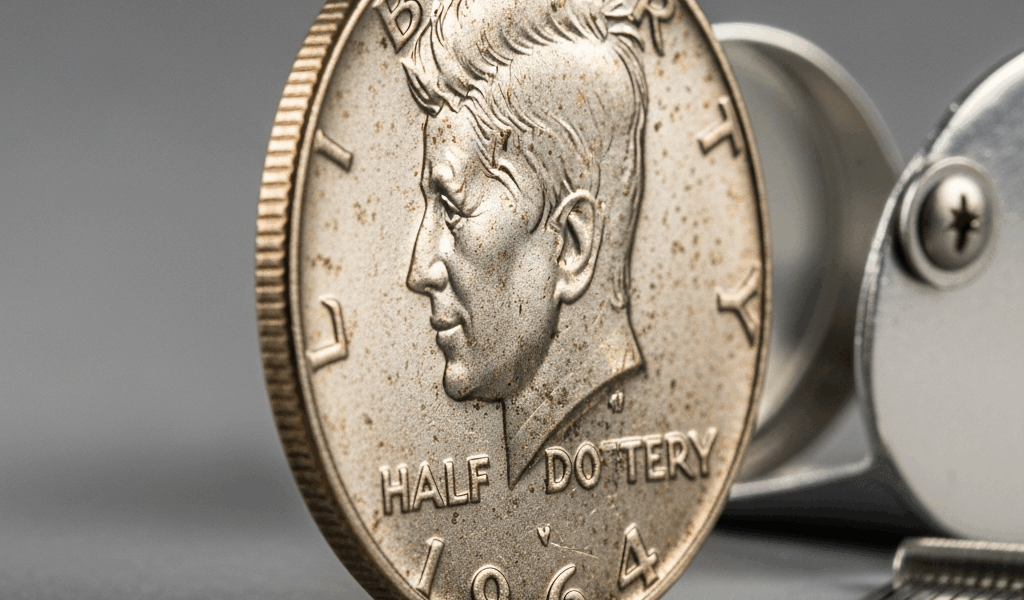
Why the 1964 Kennedy Half Dollar Is Still So Popular
Kennedy half dollar values have gotten complicated with all the misinformation flying around online. As someone who stumbled into this hobby by inheriting three shoeboxes of coins from my uncle in 2019, I learned everything there is to know about this particular coin. Today, I will share it all with you.
Here’s the short version first: the 1964 Kennedy half dollar was the first one struck after JFK’s assassination in November 1963. It’s also the last circulating U.S. half dollar made in 90% silver. That combination — historical significance plus real metal value — is exactly why people still care about these coins decades later.
The U.S. Mint pushed out over 430 million of them between Philadelphia and Denver. That’s why you keep finding them in grandma’s jars, estate sale boxes, and forgotten bank rolls. This isn’t a rare coin. It was everywhere. It’s still everywhere. But “common” doesn’t mean worthless — especially not when silver is involved. That’s what makes this coin endearing to us collectors.
Silver Melt Value and Why It Sets the Floor
Probably should have opened with this section, honestly. Before anything else about grades or mint marks, you need to understand one number: 11.25 grams. That’s how much pure silver lives inside every genuine 1964 Kennedy half. I sold my first small batch to a bank for face value — fifty cents each — before I knew this. Don’t make my mistake.
The melt value formula isn’t complicated. Total weight is 12.5 grams. Multiply that by 0.90 for the silver content, then multiply by the current silver spot price per gram. Silver trading at $0.80 per gram puts roughly $9 in your hand just from metal alone. Spot at $1.00 per gram and you’re looking at $11.25. I’ve personally watched spot prices swing $2–3 per gram inside a single month, so this number moves — but it’s always the floor.
No legitimate 1964 Kennedy half is worth less than melt value. Someone offering you $5? Walk away immediately. They’re either uninformed or betting that you are. Melt value is your protection — it means your coin has real intrinsic worth completely separate from any collector premium.
Your grandmother’s jar of Kennedy halves isn’t a lottery ticket. But it’s not pocket lint either. It’s silver bullion in coin form. There’s a meaningful difference.
1964 Kennedy Half Dollar Value by Grade and Mint Mark
Most 1964 Kennedy halves you’ll actually encounter are circulated — worn from years in pockets and cash registers. Circulated coins trade close to melt value because the numismatic premium is thin. A typical Very Fine or Extremely Fine example, whether Philadelphia or Denver, runs $11–14. You’re essentially paying melt plus a dollar or two for the convenience of not melting it yourself.
But what is grade, really? In essence, it’s a standardized measure of a coin’s physical condition and eye appeal. But it’s much more than that — grade is what separates an $11 coin from a $350 coin with the same date and mint mark.
Here’s the full breakdown:
- Philadelphia (no mint mark), circulated grades (VF–AU): $11–15
- Denver (D mint mark), circulated grades (VF–AU): $11–15
- Philadelphia, MS60–MS62: $16–22
- Denver, MS60–MS62: $16–22
- Philadelphia, MS63–MS64: $24–45
- Denver, MS63–MS64: $24–48
- Philadelphia, MS65: $65–120
- Denver, MS65: $75–140
That MS64-to-MS65 jump is real and it’s dramatic. I’ve watched the same coin type cross that threshold at a grading service and suddenly command triple what it would have fetched the week before. I’m apparently detail-blind when it comes to bag marks, and NGC catches things I completely miss — while my naked-eye assessments never quite hold up. So I stopped guessing.
MS66 and higher specimens are genuinely scarce. A Philadelphia MS66 might fetch $200–350. Denver MS66 can push $300–400. Silver spot price shifts these numbers somewhat, but the proportional gaps between grades stay remarkably consistent over time.
If your coin still has luster, shows a sharp strike, and carries minimal bag marks, grading it professionally could unlock real premium. Most people never bother. That’s a significant missed opportunity sitting in a lot of dresser drawers right now.
The Special Mint Set and Proof Versions Worth More
This is where I almost made a catastrophically expensive mistake. Found what looked like an unusually pristine, mirror-finished 1964 Kennedy half buried in a bulk lot I’d picked up for $40 at a flea market in Harrisburg. Nearly tossed it into my circulated pile. It was an SMS specimen — and I almost gave away roughly $120 because I didn’t recognize what I was holding.
The 1964 Proof Kennedy Half was struck at Philadelphia with mirror fields and frosted devices. These are underrated. A certified Proof 63 runs $40–65. Proof 65 can hit $100–180. Beautiful coins, scarcer than regular business strikes, and somehow they still don’t get the attention they deserve from mainstream collectors.
Special Mint Set specimens are where the real hidden value lives. SMS coins were produced in limited quantities specifically for collectors — mirror-like fields, superior strike quality, almost cameo-contrast appearance. No frosted finish like a standard proof, but the sharpness is immediately noticeable once you know what you’re looking at. Particularly in Kennedy’s hair detail and along the eagle’s wing feathers.
SMS in MS65 condition fetches $90–180. MS66 pushes $200–350. Legitimate premium — not marketing hype. The problem is that SMS coins look deceptively similar to regular business strikes unless you examine them carefully. That visual confusion is expensive if you’re on the wrong side of it.
If you think you might have an SMS coin, photograph it side-by-side against a standard circulated example. The difference in field reflectivity and strike sharpness becomes obvious immediately. That one comparison could mean the difference between a $12 coin and a $150 coin.
How to Tell If Your 1964 Kennedy Half Is Real
Silver-plated copper counterfeits exist. They’re rarely convincing to experienced eyes — but they exist, and I’ve personally seen two pass through a local coin show without anyone flagging them initially. Run these checks before sending anything valuable to a grading service.
Weight and dimensions: A genuine 1964 Kennedy half weighs exactly 12.50 grams and measures 30.61 millimeters in diameter. A decent jeweler’s scale runs $20–40 on Amazon — I use an AWS-100 and it’s been accurate for three years. Counterfeits typically come in light or noticeably off-dimension.
Magnet test: Silver is non-magnetic. Full stop. If the coin moves toward a magnet at all, it’s fake. Fastest initial filter you have.
Reeded edge: The edge should show distinct, tight, consistent ridges all the way around. Counterfeits frequently show sloppy, uneven, or partially missing reeding — especially when you roll the coin slowly under decent light.
Strike details: Look closely at Kennedy’s hair above the ear and the eagle’s individual feathers on the reverse. Genuine coins show crisp, well-defined lines even in high-relief areas. Fakes go soft and mushy right where detail should be sharpest.
Anything you believe grades MS65 or higher should go to PCGS or NGC before you sell it to anyone. Certification runs $25–50 per coin depending on service tier. That fee comes back instantly in buyer confidence — and often in actual sale price. Get it graded. It’s the only way to unlock what a genuine high-grade specimen is actually worth, rather than what someone at a coin show is willing to offer you on a Saturday afternoon.

Stay in the loop
Get the latest numisma news updates delivered to your inbox.