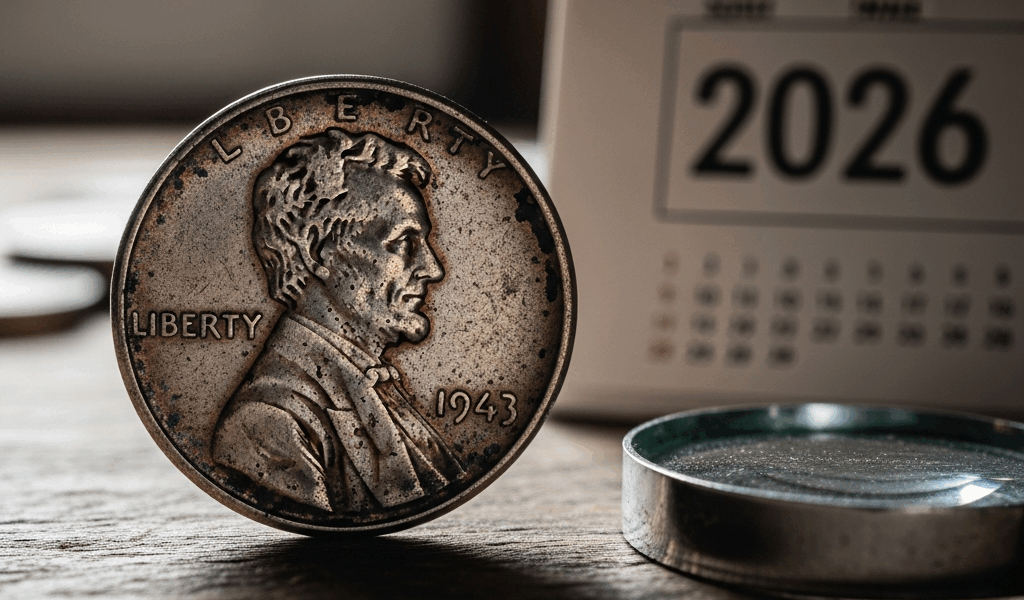
1943 Steel Penny Value — What Your Wartime Cent Is Actually Worth in 2026
1943 steel penny values have gotten complicated with all the misinformation flying around online. Everyone’s convinced they’re sitting on something extraordinary. Sometimes they are. Usually they aren’t. As someone who’s been collecting coins since my mid-twenties, I learned everything there is to know about these wartime cents the hard way — including the time I paid $18 for a coin some eBay seller called “BU” that arrived with zinc spotting all over Lincoln’s face. I currently have eleven 1943 steel cents in my collection. One I grabbed for fifty cents at a flea market. Another — a PCGS-graded MS65 — I picked up at a regional show in 2022 for $28. These are genuinely interesting coins. They’re just not rare coins. There’s a difference, and it matters.
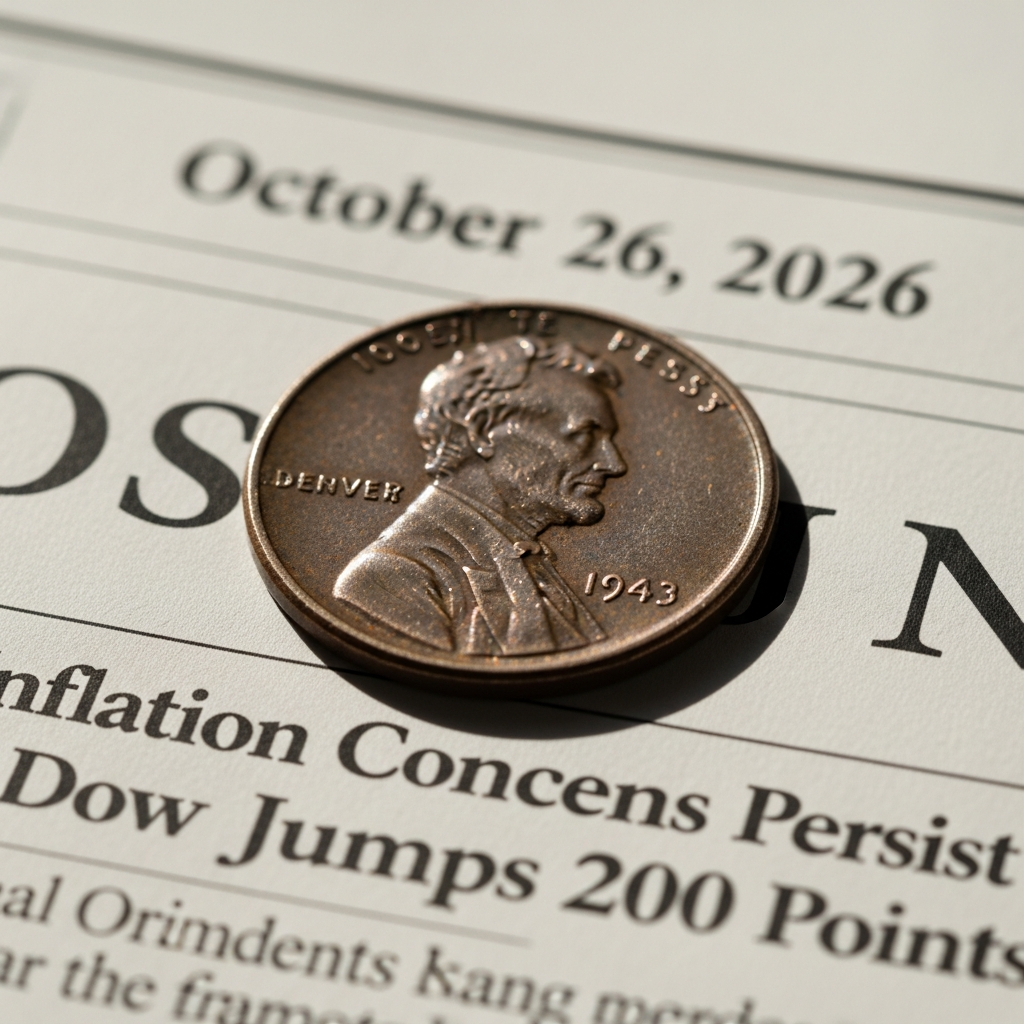
What Your 1943 Steel Penny Is Actually Worth
Let’s just get into it. Most 1943 steel pennies are worth somewhere between 20 cents and $1 in circulated condition. Not what you wanted to hear, I know. But 684 million of these were minted across three facilities in a single year. They survived in enormous numbers — partly because steel doesn’t corrode the way copper does, so coins that spent decades rattling around change jars often come out looking surprisingly decent.
Here’s what the market actually looks like heading into 2026:
- Good to Very Fine (G4–VF30): $0.20 to $0.75. Honest circulated examples. Nice to own, easy to find.
- Extremely Fine to About Uncirculated (EF40–AU58): $1 to $5. Some luster still hanging on, minimal wear. Solid for a type set.
- Mint State 60–64 (MS60–MS64): $5 to $20. This is where zinc coating condition starts mattering — a lot. Spotting and streaking hammer the grade on these.
- Mint State 65 (MS65): $25 to $50. Genuinely tough to find with clean surfaces. That $28 coin I mentioned? Right here.
- MS66 and MS67: $75 to $300+. Legitimately scarce at this level. Surface preservation is everything.
- MS68 and above: $1,000 to several thousand dollars. Virtually gem-perfect. PCGS and NGC combined have graded only a handful at this level across any mint.
Don’t make my mistake. Raw coins listed as “uncirculated” by dealers on eBay are almost never MS65 material — honestly, they’re rarely even close. That spotty coin I mentioned earlier? A third-party grader would have called it MS62 at best. Buy graded when you’re spending real money on these. Full stop.
Why 1943 Pennies Were Made of Steel
Copper was a war material. The U.S. military needed it for ammunition casings — brass cartridges being manufactured by the hundreds of millions for the Allied war effort. The Mint couldn’t justify running 95% copper cents when the metal was that desperately needed overseas.
The solution was a zinc-coated steel planchet. Each coin came out 2.70 millimeters thick, weighing 2.70 grams — lighter than the standard copper cent at 3.11 grams. The zinc coating was applied at 0.001 inches thick, which sounds like nothing. In practice, it was nothing. It wore off easily, exposed the steel underneath to moisture, and the coins rusted. Finding a 1943 cent with reddish-brown rust spotting is genuinely common — and it kills the grade instantly. The Mint reportedly hated these coins. So did the public, who complained they looked like dimes and kept jamming vending machines.
Identifying a genuine steel cent is simple. Put a magnet near it. Steel cents stick. Copper cents from other years don’t. This same test has a much more important application — I’ll get to that shortly.
One identification trap worth knowing — copper-plated 1943 steel cents exist in large numbers. Someone figured out you could plate steel coins with copper and make them look exotic. These are worth exactly what a normal steel cent is worth: almost nothing. They stick to a magnet. Real 1943 copper cents do not.
The 1943 Copper Penny — The Real Prize
Probably should have opened with this section, honestly. This is what most people are actually hoping they have.
But what is a 1943 copper penny? In essence, it’s an accident — a cent struck on a leftover bronze planchet from 1942 production that got fed through the presses after the Mint switched over to steel. But it’s much more than that. It’s one of the most sought-after error coins in American numismatic history.
Frustrated by the impossibility of catching every stray planchet during a massive wartime changeover, Mint workers apparently didn’t catch them all — and a small number of 1943 cents ended up struck on the same 95% copper, 5% tin-and-zinc composition used in 1942.
How many exist? Estimates range from 20 to 40 genuine examples across all three mints, with Philadelphia being the most common of the three rarities. The 1943-S copper cent is considered the king of the series — only one or two confirmed specimens. The 1943-D copper cent has a confirmed population of around five to seven coins.
Values are extraordinary. A 1943 Philadelphia copper cent in MS64 Red sold at auction for over $180,000. A 1943-S copper cent crossed $1 million. These are not coins you quietly pocket after finding them in an old coffee can. They’re verified by major third-party grading services, catalogued, pedigreed, and known to the collecting community.
After reading about these years ago, I started testing every 1943 cent I came across with a strong neodymium magnet — the N52 grade ones, which cost about $8 for a small set on Amazon. The process takes two seconds. Hold the magnet near the coin. If it pulls, it’s steel. Walk away. If there’s zero magnetic attraction, you have something worth getting looked at immediately.
Almost every “1943 copper penny” that surfaces online or at shows is one of three things: a copper-plated steel cent (sticks to magnet), a 1948 cent with the “8” altered to look like a “3” (doesn’t stick, but the date looks wrong under a loupe), or a genuine error from a different year. Authentic 1943 copper cents are almost always already known to the collecting world. But almost always isn’t always — so get it tested if your magnet test comes back clean.
Mint Mark Values — Philadelphia vs Denver vs San Francisco
Three versions of the 1943 steel cent exist, and they’re not created equal — though the differences are smaller than most people expect.
1943 Philadelphia — No Mint Mark
Philadelphia struck the lion’s share of that 684 million total — approximately 484 million steel cents on its own. These are the most common by a wide margin. Circulated examples trade for 25 to 50 cents all day long. High-grade MS65 examples sit at $25 to $40. That’s what makes the Philadelphia cent endearing to us collectors — it’s the accessible entry point into an otherwise expensive hobby segment.
1943-D — Denver
Denver produced around 217 million steel cents in 1943 — identifiable by the small “D” mint mark below the date on the obverse. Slightly scarcer than Philadelphia across all grades, but not dramatically so. Circulated examples carry a modest premium, maybe $0.50 to $1.25. An MS65 runs $30 to $50. Where Denver really pulls ahead is in gem uncirculated territory — population reports consistently show fewer surviving MS66 and MS67 examples compared to Philadelphia.
1943-S — San Francisco
San Francisco struck approximately 191 million steel cents — the fewest of the three mints, with the “S” mint mark sitting below the date in the same location. In circulated grades the premium is modest: $0.75 to $2.00. But in higher mint state grades, the 1943-S pulls meaningfully ahead. An MS65 example can reach $50 to $75. MS66 and above? You’re looking at $200 to $500 depending on surface quality and registry competition.
The 1943-S also holds a particular distinction — it’s the mint that produced the rarest copper error. If you find a 1943 cent that passes the magnet test and shows an “S” mint mark, the value conversation changes entirely.
A Quick Note on Grading Services
Third-party grading from PCGS or NGC might be the best option for any 1943 steel cent worth more than about $30, as this hobby requires confidence in what you’re actually buying. That is because slabbed examples sell more easily, grade more consistently, and protect you against doctored coins. PCGS charges around $30 for economy tier grading as of 2026. For a circulated example in a flip? Not worth it. For anything MS65 or above — or anything that might be an error — absolutely worth it.
First, you should do the magnet test on every single 1943 cent you encounter — at least if there’s any chance you might have a copper example hiding in the stack. Then worry about grade. The 1943 steel penny is one of those coins almost every American family has tucked away somewhere — a tangible piece of World War II on the home front, a reminder that the war touched everything, even the change in your pocket. Go in with realistic expectations about the value. Do the magnet test. Keep your eyes open. The copper version is out there somewhere.


Stay in the loop
Get the latest numisma news updates delivered to your inbox.