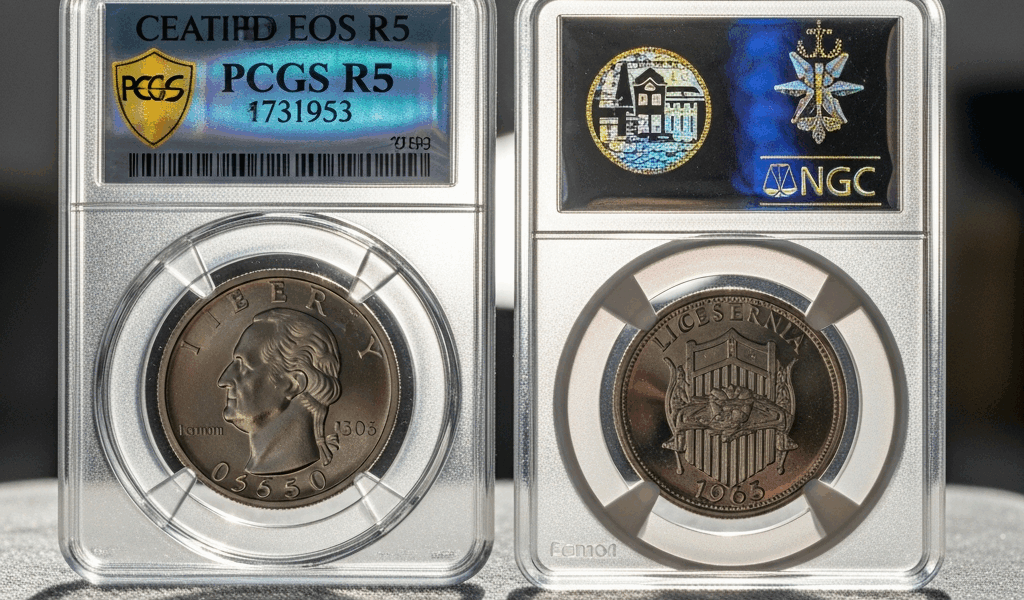
PCGS vs NGC — Which Coin Grading Service Should You Use
Coin grading has gotten complicated with all the conflicting noise flying around online. As someone who spent three years buying raw coins and flipping them without thinking much about holders, I learned everything there is to know about this debate the hard way. Don’t make my mistake. When I finally started grading coins regularly, I had to pick a service — and nobody gave me a straight answer. Everything I read had an agenda. So here’s the comparison I wish existed back then: no affiliate deal, no loyalty to one slab, just what actually matters when you’re deciding where to send your coins.
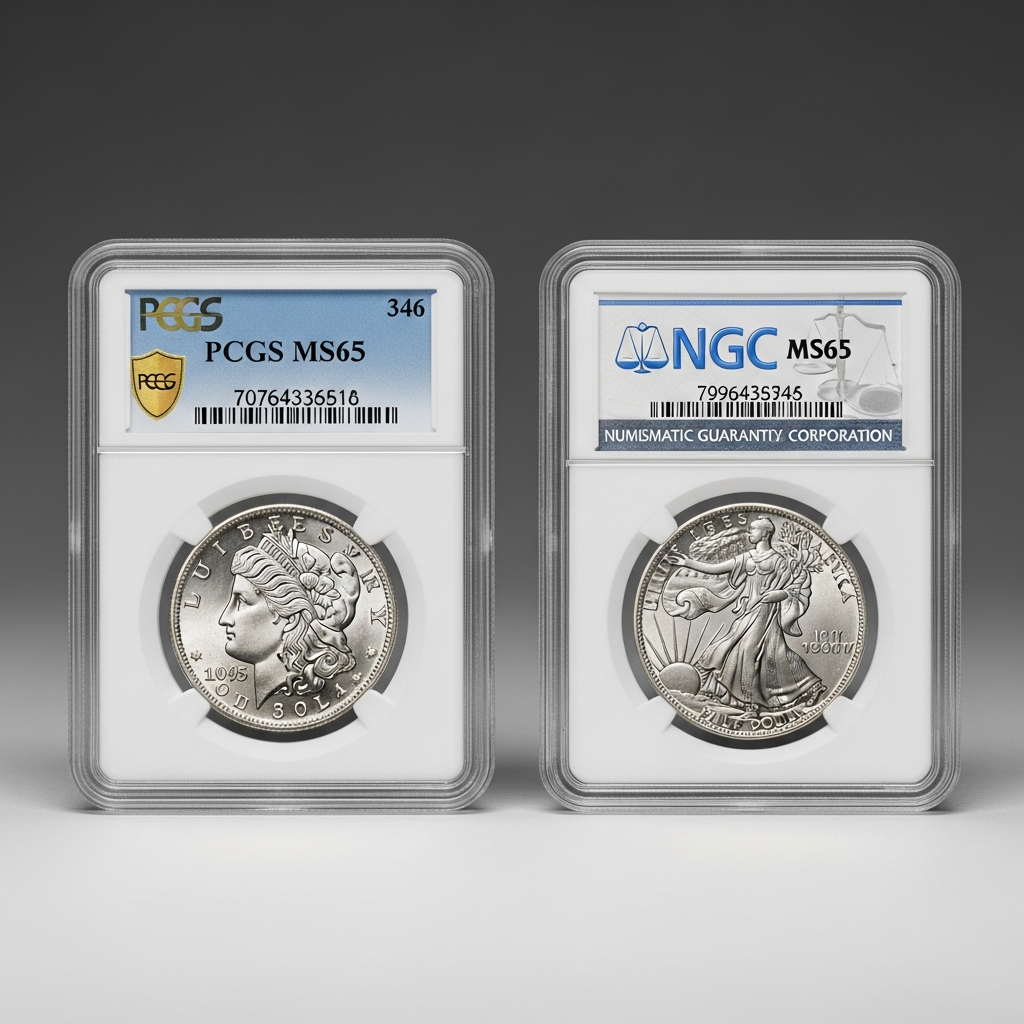
Both services are legitimate. Both have been around for decades. The Professional Coin Grading Service launched in 1986. Numismatic Guaranty Company followed in 1987. Between them, tens of millions of coins certified. Picking a side matters less than understanding when each one serves your specific goals better.
Grading Standards — Do They Actually Grade Differently
This is the question that generates the most heat in any coin forum. Honest answer: yes, sometimes — but probably not in the way you think.
Neither service publishes a hidden formula. Both use the Sheldon scale from 1 to 70. Both employ teams of professional numismatists who examine coins under magnification and assign a grade. On paper, an MS-65 from PCGS and an MS-65 from NGC represent the same standard. In practice, there are observable differences depending on the series.
Population Reports and What They Tell Us
Both services maintain population reports — databases of every coin they’ve ever certified, broken down by date, mintmark, and grade. PCGS calls theirs the Population Report. NGC calls theirs the Census. Smart collectors cross-reference both constantly. Publicly accessible, both of them.
Here’s where it gets interesting. For certain series — Morgan dollars, early American copper, key-date Walkers — the PCGS population in the top grades runs significantly thinner than the NGC census. A coin graded MS-65 by PCGS in a scarce date might show 40 examples while NGC lists 110. That gap reflects two things: PCGS’s historical tendency to grade slightly tighter on certain series, and the market preference that pushes more high-value coins toward PCGS submission in the first place.
Neither of those things means PCGS is always tougher. For modern coins — anything from the 1990s onward — the grading gap essentially disappears. I’ve sent same-era Presidential dollars to both services and gotten consistent results. The tightness difference shows up most reliably in classic U.S. series pre-1933.
Does PCGS Actually Grade Tighter
Short answer: on classic coins, PCGS has historically maintained tighter standards in specific high-demand series. On modern issues, the difference is negligible. The longer answer involves understanding that grading is still partly subjective — and standards shift over time at both services.
There’s also a concept collectors call “market grading” — the idea that a coin’s grade reflects what the market expects that grade to look like, not just a mechanical checklist. Both services do this. It means a premium-quality MS-63 from either service might look like what another era called MS-64. That’s not fraud. That’s an evolving standard. Worth knowing before you expect perfect consistency across decades of slabs.
CAC as a Third-Party Check
Probably should have opened with this section, honestly — because once you understand CAC, a lot of the PCGS vs NGC debate becomes less urgent.
But what is CAC? In essence, it’s an independent verification service founded by John Albanese — one of PCGS’s original founders, which is a fun detail. But it’s much more than that. CAC stickers — green for coins that meet or exceed the standard for their assigned grade, gold for coins that deserve the next grade up — apply to slabs from both PCGS and NGC. A PCGS MS-65 with a green CAC sticker is widely accepted as a coin that genuinely belongs in that grade. Same for NGC.
For buyers, CAC-stickered coins at both services trade at premiums above unstickered examples. For sellers, getting a coin CAC-verified before sale can add 10 to 20 percent on the right coin. Extra step, extra fee — CAC charges based on coin value — but for anything worth over $500, it’s worth considering regardless of which service graded it.
The practical takeaway: a CAC-stickered NGC coin often outcompetes a raw PCGS coin in the same grade. The holder matters, but quality within the holder matters more.
Pricing and Turnaround Times in 2026
Money is the part most articles skip over or bury in footnotes. Here’s the actual cost structure as of early 2026 — this stuff changes, and the numbers matter when you’re sending in ten coins at once.
PCGS Tier Structure
PCGS operates on a membership model. An annual membership runs $69 for the basic tier, which gets you access to their submission portal and standard pricing. Without membership, you submit through an authorized dealer and pay dealer markups on top of service fees — which adds up faster than you’d expect.
Their service tiers for most U.S. coins break down roughly like this. Economy service — declared value under $300 per coin — runs around $22 per coin with an estimated turnaround of 45 to 65 business days. Regular service sits at $30 per coin with a 20 to 30 business day window. Express jumps to $65 per coin with a 5 to 10 business day target. World coins and bullion tiers differ from these numbers. High-value coins above $10,000 declared value move to different fee structures entirely — often percentage-based.
Turnaround times are estimates. I sent a batch of 12 coins on the Regular tier in October 2025 and received them back in 34 business days. On the longer end of the window, but within it. No complaints — grading takes time when done carefully.
NGC Tier Structure
NGC does not require a membership for basic submissions — a meaningful difference for newer collectors. Anyone can submit directly through their website. Their Economy tier — coins under $300 declared value — runs approximately $18 per coin with a 50 to 60 business day estimate.
Standard service at NGC runs around $25 per coin with a 15 to 25 business day window. Express is roughly $55 per coin for 5 to 10 business day service. NGC also offers a Bulk service for modern coins — specific criteria apply — at around $12 to $15 per coin for large lots. PCGS doesn’t match that price point.
NGC’s lower-tier pricing is genuinely cheaper. On a batch of 20 economy submissions, you save roughly $80 going NGC over PCGS. Real money. For a collector building a type set from circulated silver, that difference adds up across a year of submissions.
The Real Total Cost
Add shipping — always insured, always trackable, both ways. For a typical submission, round-trip registered mail or FedEx with declared value insurance adds $25 to $60 depending on total declared value. Then factor in the dealer markup if you’re not submitting directly. Then CAC fees if applicable. Grading a $200 coin on economy tier and getting it CAC-verified is genuinely not cheap relative to that coin’s value. Know your numbers before you send anything.
Market Premium — Does the Holder Matter
Yes. Unambiguously, for certain coins, in certain markets. The PCGS holder commands a price premium over NGC for the same coin, same grade, in classic U.S. series. That premium ranges from about 5 percent on the low end to 15 percent or more on coins where PCGS population data is thin and demand is high.
I tracked completed eBay sales for 90 days on 1881-S Morgan dollars in MS-65 — straightforward experiment, spreadsheet and coffee, nothing fancy. The data wasn’t ambiguous. PCGS MS-65 examples averaged $340. NGC MS-65 examples averaged $295. That’s a 15 percent gap on a liquid, frequently-traded coin. Both coins meet the MS-65 standard. The PCGS holder simply carries more buyer confidence in that series.
Why the Premium Exists
A few reasons — none of them conspiracy. PCGS has historically had stronger brand recognition among high-end type coin collectors and auction house specialists. Heritage Auctions, Stack’s Bowers, Legend Numismatics — the major players — all sell PCGS and NGC coins, but realized price records in classic series skew heavily toward PCGS. That creates a feedback loop. Buyers pay more for PCGS because the data says PCGS gets higher prices, which means PCGS keeps getting higher prices.
There’s also the tighter-grading perception — warranted or not — which means buyers assume a PCGS MS-65 has been vetted more rigorously. Whether that’s statistically true across all series is debatable. The market belief is not debatable. It’s built into the prices.
When the Premium Does Not Matter
Modern coins. Bullion. Coins under $150 total value. World coins. Proof sets. For all of these categories, the PCGS premium either vanishes or shrinks to noise. A 2020 American Silver Eagle in MS-70 gets nearly identical money in PCGS or NGC holders — both services certify millions of these, the populations are enormous, and buyers know it. A PCGS PR-70 on a common-date modern proof might fetch $5 more than NGC. Not a reason to pay a higher grading fee.
The premium is most meaningful on pre-1965 U.S. coins, key dates, early American coins, and anything with a thin PCGS population relative to NGC. Know your series before you decide where to submit.
The Verdict — Which to Use When
Here’s the actual position — not a hedge.
High-Value Classic U.S. Coins — Send to PCGS
PCGS might be the best option here, as classic coin sales require maximum market confidence. That is because the holder premium is real, documented in completed sales data, and the thinner population in key series means your coin stands out when buyers check the reports. Pay the higher submission fee. It comes back in resale value on virtually any liquid classic series coin.
This applies especially to Morgan dollars, Peace dollars, Walking Liberty halves, Buffalo nickels in gem grades, and early American coins. These are the series where PCGS reputation is strongest and the market premium is most consistent.
Modern Coins and Bullion — Either Works, NGC Saves Money
For anything struck after 1965 — and especially for bullion coins like Eagles and Maples — NGC’s lower pricing is a genuine advantage with no market penalty. Populations at both services for modern issues run into the hundreds of thousands. Nobody pays a PCGS premium for a common-date Silver Eagle. Send it to NGC economy, save $4 to $7 per coin, reinvest that money in coins that actually matter.
Budget-Conscious Submissions on Modest Coins
First, you should calculate your grading cost as a percentage of coin value — at least if you’re working with material in the $100 to $300 range. NGC’s economy tier at approximately $18 per coin, combined with no mandatory membership fee, makes it the right call here. The math is simple: $22 versus $18 per coin on a $150 coin is a bigger slice of your investment than on a $1,500 coin. NGC’s economy service is competent. Coins come back properly graded in solid holders. No scandal in using it.
The One Thing Both Services Do Equally Well
Authentication. Both PCGS and NGC catch fakes. Both have caught fakes on coins that fooled experienced dealers. Both provide a guarantee — if a coin in their holder is later determined to be counterfeit, they’ll compensate the owner at the grade value. That guarantee has real dollar value for any coin worth grading. Raw coins have no such protection.
That’s what makes authentication endearing to us collectors — it’s the one part of this hobby where the answer is genuinely simple. Stop buying expensive raw coins without intending to grade them. The grading fee is insurance as much as it is a marketing tool. A $600 raw Morgan dollar with no authentication history is a gamble. The same coin in a PCGS or NGC holder — even if it grades lower than you hoped — is a known quantity. Buy the coin, not the raw guess.
Final Call
PCGS for classic coins you intend to sell at maximum value. NGC for modern coins, bulk submissions, and budget-constrained collections where service quality is indistinguishable but the price is meaningfully lower. CAC verification for anything important regardless of which service graded it. And don’t let the holder debate distract you from the actual work — finding undervalued coins that are worth grading in the first place.


Stay in the loop
Get the latest numisma news updates delivered to your inbox.