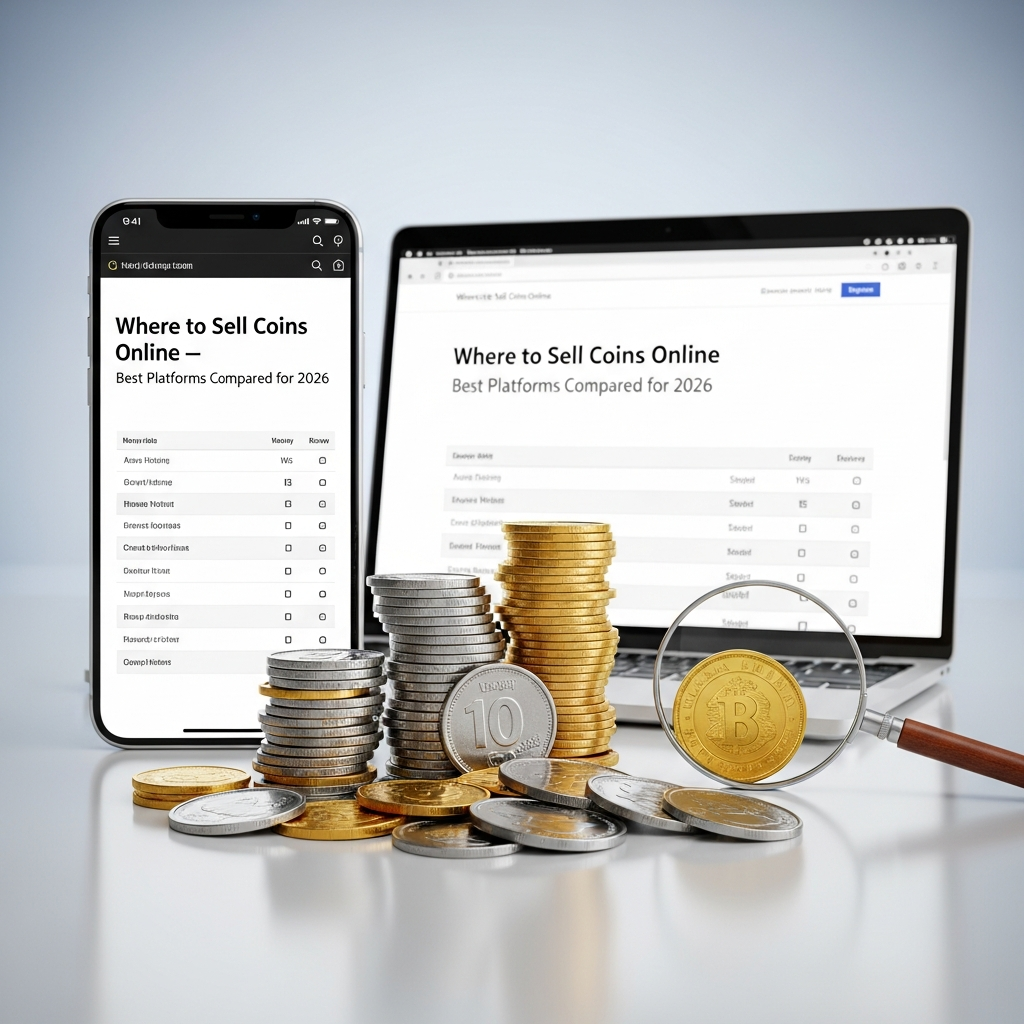
Where to Sell Coins Online — Best Platforms Compared for 2026
Selling coins online has gotten complicated with all the conflicting advice flying around. As someone who spent eight years buying, trading, and selling through nearly every major platform out there, I learned everything there is to know about this fragmented, fee-heavy market. Today, I will share it all with you.
It started with an inheritance — my grandfather’s collection, mostly Morgan dollars and some foreign currency from the 1970s. What began as idle curiosity eventually turned into something more serious. I started noticing patterns. Which platforms actually paid. Which ones quietly drained 25-30 percent before you saw a single dollar.
Most articles skip the fee math entirely. Or they’re written by the platforms themselves. Don’t make my mistake of learning this the expensive way.
eBay — Biggest Audience, Highest Fees
eBay is where most people go first. Obvious choice. Familiar interface. Statistically, it holds the largest pool of active coin buyers anywhere online.
But what is eBay’s real cost to sellers? In essence, it’s a 13 percent final value fee on coins, plus payment processing that runs another 2.35 percent and $0.30 per transaction. But it’s much more than that when you factor in shipping.
Here’s a real number. I sold a 1921 Morgan dollar in decent circulated condition for $85. Fees totaled $13.19. Tracked shipping cost $4.50. My actual take-home: $67.31. That’s 79 percent — not the 87 percent the flat fee implies. Shipping quietly eats the difference.
eBay works for common coins, modern mint sets, circulated material under $50. Auction format generates competitive bidding. The sheer buyer volume means faster sales — usually 7 days or less. That’s what makes eBay endearing to us casual volume sellers. It’s predictable, even if it’s expensive.
The risks, though. Returns happen constantly. Buyers claim condition doesn’t match photos. Fraud creeps in — payment disputes, false item-not-received claims. I’ve had two returns go against me in eight years despite accurate grading and detailed photo sets. eBay’s seller protection with coins specifically is inconsistent. Unreliable, honestly.
Use eBay for volume, not value. Moving inventory fast. Not squeezing every dollar out of a single piece.
Heritage Auctions — Best for High-Value Coins
Heritage Auctions might be the best option for serious numismatists, as high-end coin sales require an audience that actually understands what they’re bidding on. That is because Heritage has spent decades building exactly that buyer pool — no casual browsers, just collectors who know coins.
Their fee structure is straightforward. Heritage takes 10 percent from the seller. You keep 90 cents per hammer dollar. The catch — and it’s a real one — is the 20 percent buyer’s premium, which affects what bidders are actually willing to offer. A coin that might fetch $1,000 retail could land at $800 hammer price because the buyer calculates their total cost upfront.
In 2023, I submitted three coins — valued roughly $200, $280, and $390 — to Heritage. Auctioneer estimates came back conservative, which is standard practice. One sold. Two didn’t clear reserve. The listing fee was $20 per lot, regardless. Learned that lesson fast: Heritage is designed for coins over $500. Below that threshold, the economics get uncomfortable for everyone involved.
The timeline is slow. From submission to payment, expect 8-12 weeks minimum. They photograph professionally. Catalog extensively. Handle authentication. If you’re patient and selling something genuinely valuable, that process is worth every week of waiting. If you need money in March, don’t submit in February.
Direct to Dealer — Fast Cash, Lower Price
Frustrated by eBay disputes and Heritage timelines, I started walking into local coin shops about three years ago. It changed how I think about the whole selling equation.
Dealers buy at 60-70 percent of retail value and sell at full retail. That’s the model. No shortcuts. A $100 retail coin gets you $60-70 in cash — maybe $75 if the dealer’s running low on inventory and needs to restock.
Sounds painful compared to eBay’s 84 percent take-home. Until you do the full math. Immediate payment. Zero fees. Zero waiting. Zero returns. I sold a roll of 20 uncirculated American Eagles — roughly $650 retail value — to a local dealer for $420. Cash. Done in 15 minutes. No shipping label. No listing photos. No waiting for a buyer who might file a dispute two weeks later.
Online dealers operate similarly. APMEX, JM Bullion, Goldstar — they all run buy-back programs. Mail your coins, they evaluate and grade, they send an offer, you decide. I’ve gotten 72 percent of retail from JM Bullion on modern bullion — slightly better than most local shops because they operate at higher volume and turn inventory faster.
Probably should have opened with this section, honestly. A lot of collectors don’t realize dealers are even an option. They assume it’s eBay or nothing. The trade-off is simple: you’re exchanging maximum return for certainty and speed. Depending on your situation, that’s a completely reasonable trade.
Reddit and Forums — Peer to Peer
The collector community built its own marketplace — primarily r/Coins4Sale on Reddit and several specialized numismatic forums. This is where I’ve personally made the most money per coin. No platform taking 13 percent. Direct conversation with buyers who understand exactly what they’re looking at.
I’m apparently a decent negotiator and this method works for me while eBay’s auction format never quite does. Last year I sold a 1950-D Franklin half dollar graded MS-64 through r/Coins4Sale for $220. Total fees: roughly $4.50 on the PayPal Goods & Services payment. That’s it. The buyer knew what they were buying — we discussed it thoroughly, examined photos, agreed on price. Clean transaction.
The catch is reputation. New accounts can’t move high-value coins — at least not to buyers who know what they’re doing. You need verified transaction history, confirmed positive feedback, ideally 5-10 completed sales before the community trusts you with anything over $500. That’s not a flaw. That’s actually what makes these forums endearing to us collectors. The self-policing works. Scammers get identified, banned, and reported across multiple forums within hours.
Realistically, expect 85-95 percent of fair market value here. The range depends on grading accuracy, condition, and timing. You’re negotiating with informed buyers who’ve already looked up what your coin sold for at Heritage last quarter. Bring accurate descriptions — at least if you want deals to close smoothly.
The effort is real. You answer questions. Take extra photos. Explain your grading logic. But for a $300 coin paying $4.50 in total fees instead of $48, the math justifies the work.
Fee Comparison at a Glance
- eBay: 13% final value fee + 2.35% + $0.30 payment processing = roughly 16% total. Effective take-home: ~84% before shipping.
- Heritage Auctions: 10% seller premium + $20-50 listing fees per lot. Effective take-home: 80-90% on coins that actually sell.
- Dealers: No fees. Immediate cash at 60-70% of retail — sometimes 72-75% through high-volume online buyers like JM Bullion.
- Reddit/Forums: Shipping, insurance, and ~1.5% PayPal split. Effective take-home: 85-95% of fair market value.
Which Platform for Your Coins?
Common circulated coins under $50? eBay. The audience is there, volume matters, and the fee percentage hurts less at lower price points.
Rare coins over $500? Heritage. Their authentication infrastructure and collector audience exist specifically for this. The timeline is worth it.
Need cash this week? Dealers. Accept 60-70 percent, get certainty, move on.
Willing to invest real effort for maximum return? Reddit and forums. That’s where collector-to-collector deals happen at actual fair market prices — no middleman skimming the margin.
My inherited Morgan dollars went through Heritage — valuable pieces, wanted professional documentation. Circulated Kennedy halves from a mixed lot? eBay. Modern bullion I needed to liquidate fast? Local dealer, $420 cash, 15 minutes. Duplicate coins I turned up during sorting? Reddit, no fees, fair price.
I’m apparently a multi-platform seller now and the approach works for me while treating every coin the same way never did. The early mistake was assuming one platform could handle everything. It can’t — each one has a specific use case and a specific buyer pool that it serves well and others it doesn’t.
So, without further ado: run the numbers before you list anything. Match your coins to the right platform. That math — done honestly before you ship a single coin — is the difference between 65 percent and 93 percent of what your collection is actually worth.


Stay in the loop
Get the latest numisma news updates delivered to your inbox.