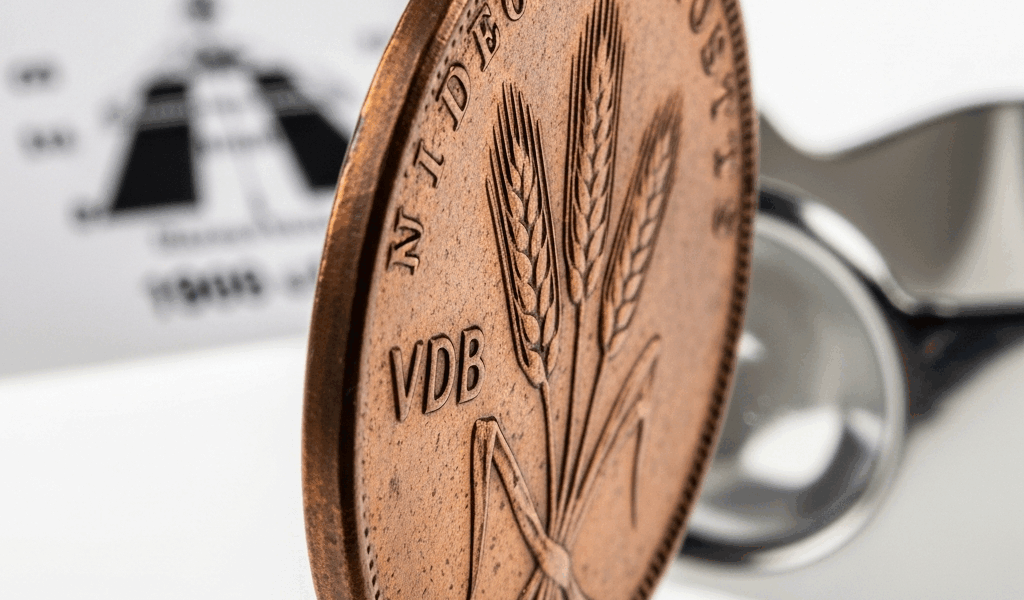
Why the 1909-S VDB Is Such a Big Deal
Lincoln cent collecting has gotten complicated with all the misinformation flying around. So today, I will share everything I know about the 1909-S VDB — what it’s worth, why it matters, and how to avoid getting burned.
The whole thing comes down to numbers. Philadelphia struck roughly 27 million Lincoln cents with Brenner’s initials in 1909. San Francisco? Just 484,000. That’s not a small gap. That’s a chasm — and most people don’t feel the weight of it until they spend a year hunting for one in decent shape.
But what is the 1909-S VDB, exactly? In essence, it’s a Lincoln wheat cent struck at the San Francisco Mint during a narrow two-month window before the Treasury ordered Brenner’s initials removed. But it’s much more than that. It’s the intersection of political embarrassment, bureaucratic overreaction, and dumb luck that created one of the most sought-after coins in American numismatics.
Here’s the backstory. When Victor David Brenner’s initials — V, D, B — appeared on the reverse of the brand-new Lincoln cent, newspapers lost their minds. Editorials called it vanity. Some critics genuinely claimed the letters looked like secret symbols. By mid-1909, the outrage had gotten loud enough that Mint leadership ordered the initials stripped from the dies entirely. That decision came down in June 1909. San Francisco had already shipped its small run. Nobody stopped it in time.
That’s what makes the 1909-S VDB endearing to us collectors. It wasn’t planned as a rarity. It just happened — the result of slow communication, fast presses, and a public that had opinions about coin design. The Philadelphia version, with no mintmark, exists in the tens of millions. The S-mint? 484,000 total. Circulated hard for decades. The ones that survived in anything resembling nice shape are genuinely scarce.
I spent three years assembling a Lincoln cent collection before I physically held a 1909-S VDB. When I finally did — a raw VF30 I picked up at a show in 2019 for around $340 — I understood why dealers handle these with cotton gloves and a flashlight. It’s a real coin with real history. The Philadelphia version sits in the background by comparison. Affordable, common, almost uninteresting to specialists. The S-mint version is what separates collectors from people who throw coins into a jar and forget about them.
How to Find the S Mintmark and VDB Initials
Probably should have opened with this section, honestly — I’ve talked to collectors who owned one of these for years without knowing what they had.
So, without further ado, let’s dive in. The S mintmark sits directly below the date on the obverse, the front face of the coin. On a genuine example, “1909” appears in the center, and a small serif letter S sits just underneath — lower left quadrant, close to the rim. It’s not microscopic, but it doesn’t announce itself either. Under decent light, a real S shows crisp edges, consistent depth, and sharp little serif feet. That detail matters later when we talk about fakes.
Flip the coin over. The VDB initials run along the bottom rim of the reverse, near the right wheat stalk. Three small letters — V, D, B — each about 2 millimeters tall, curving slightly with the edge of the coin. On a well-struck example, the serifs are clean. The relief is even across all three letters. They don’t blur into the rim.
Here’s what trips people up. The initials were removed from Philadelphia dies later that same year, which means a 1909 cent with VDB and no mintmark is completely legitimate — and worth maybe $15. But a coin showing both the S mintmark and the VDB initials? That’s the specific two-month production window. That’s the key date. That’s value.
Weakly struck examples — where the S or VDB look flat — can still be genuine. Poor strikes happened at the Mint itself. They don’t indicate counterfeiting. They do indicate lower eye appeal, which drops the resale price noticeably.
1909-S VDB Value by Grade and Condition
I’m pulling these figures from recent PCGS and NGC auction results. Prices shift monthly, so treat this as a realistic baseline — not a guarantee, not wishful thinking.
Good (G4) to Fine (F12)
Heavy wear. Lincoln’s profile survives, but the fine details are mostly gone. Wheat stalks on the reverse are flat. Expect to pay $50 to $120 for a raw coin in this range, depending on surface damage and any cleaning. A certified G4 from PCGS or NGC typically trades around $75 to $150. These coins lived hard lives — cash registers, coat pockets, vending machines. They’re affordable entry points. Don’t expect beauty.
Very Fine (VF20) to Extremely Fine (EF40)
Now you’re looking at coins with actual detail. In VF20, Lincoln’s cheek and jawline show clear relief. The wheat stalks have visible separation between the lines. An EF40 shows sharp hair detail and bold wheat definition on both sides. Raw EF40 examples run $200 to $500. Certified EF40 from a major grader costs $300 to $700 depending on eye appeal and surface marks. This is where serious collectors start committing real money — though they haven’t yet entered true investment-grade territory.
About Uncirculated (AU55)
Light friction only. High points keep original mint luster in patches. The cheek might show faint wear, but the reverse wheat is nearly pristine. Raw AU55 examples fetch $500 to $1,200. Certified AU55 pieces command $800 to $1,800. At this level, the difference between a dull AU55 and an attractive one can swing the price by $400 or more. Eye appeal is doing real work here.
Mint State (MS63 and MS65)
Here’s where rarity bites hard. A genuine 1909-S VDB in MS63 — uncirculated, minor bag marks, honest imperfections — sells for $2,500 to $4,500 depending on the grading service and surface quality. MS65 specimens, with brilliant fields and exceptional strike, trade between $6,000 and $12,000. I’ve seen outliers in both directions, especially for coins with original red luster or documented provenance. But those are the realistic bands for typical examples.
Market conditions matter. During strong numismatic cycles, Mint State pieces push toward the top of those ranges fast. During soft markets, they retreat. Stick with PCGS or NGC certification for anything above AU50. At these price points, third-party authentication isn’t optional — it’s the whole game.
Red Flags — Altered Dates and Fake Mintmarks
Counterfeits exist. Don’t make my mistake of assuming the market self-corrects. It doesn’t always — especially at shows and on low-oversight online platforms.
The most common fake starts with a 1909 VDB from Philadelphia. Common coin, worth almost nothing. A fraudster adds an S mintmark using a die, punch, or engraving tool, and suddenly it looks like a $300 coin. Under 20x magnification, a genuine S sits in its own recessed area, with consistent depth and crisp serif edges. A tooled S looks different — shallower, with irregular borders. The surrounding field shows microscopic scratches or surface disruption where something pressed into the metal. That damage doesn’t belong there.
The second alteration is trickier. Someone takes a genuine 1909-S — worth real money even without the initials — and adds fake VDB letters to the reverse. Trained graders catch this. Real VDB initials integrate naturally with the die. They sit at consistent depth along the rim. Fake initials often show inconsistent relief. They may appear slightly elevated above the surrounding surface or sit at a slightly wrong angle. The difference is subtle. That’s why it works on casual buyers.
While you won’t need a full laboratory setup, you will need a handful of tools — at minimum a 10x loupe, ideally a 20x jeweler’s magnifier, and good directional light. First, you should check the mintmark under magnification — at least if you’re considering spending more than $100. A PCGS or NGC submission costs $30 to $50 per coin. On a $500 purchase, that fee is cheap insurance. On a $5,000 purchase, it’s non-negotiable.
Should You Get It Graded Before You Sell
It depends on what you’re holding. Genuinely.
If your 1909-S VDB shows heavy wear — Good through Very Fine — professional grading might cost more than the premium it adds. Raw coins in that range move fine through online auctions or directly to dealers. You’ll eat a small discount, but you’ll close the transaction. I’m apparently a decent eye-grader for worn copper and selling raw G4-VF20 pieces directly works for me while chasing slabs for that range never makes financial sense.
Anything grading AU50 or above? Submit it. The gap between an unslabbed AU55 and a certified AU55 isn’t just paperwork — it’s legitimacy and a price premium. Buyers at that level want the PCGS or NGC holder. They want the certification number they can look up. A $25 submission fee on a coin worth $1,500 is math that works every time.
Mint State coins? Grading is mandatory. Nobody hands over $5,000 for a raw, unslabbed coin — or they shouldn’t, anyway. You need the certification label, the population report printed on the back of the holder, and the security that comes with a recognized third party staking its reputation on the grade.
NGC might be the best option for budget-conscious sellers, as the 1909-S VDB requires a trustworthy submission process. That is because both major services carry market recognition, but NGC’s standard tier runs slightly cheaper for single-coin submissions. Check current turnaround times before committing — they fluctuate, and waiting four months to sell an AU coin you needed to move last fall is its own kind of expensive.
Once you’ve had your 1909-S VDB assessed, check out our full guide on where to sell coins online. The right platform depends heavily on grade — but quality coins with solid documentation find buyers faster than almost anything else in the hobby.


Stay in the loop
Get the latest numisma news updates delivered to your inbox.