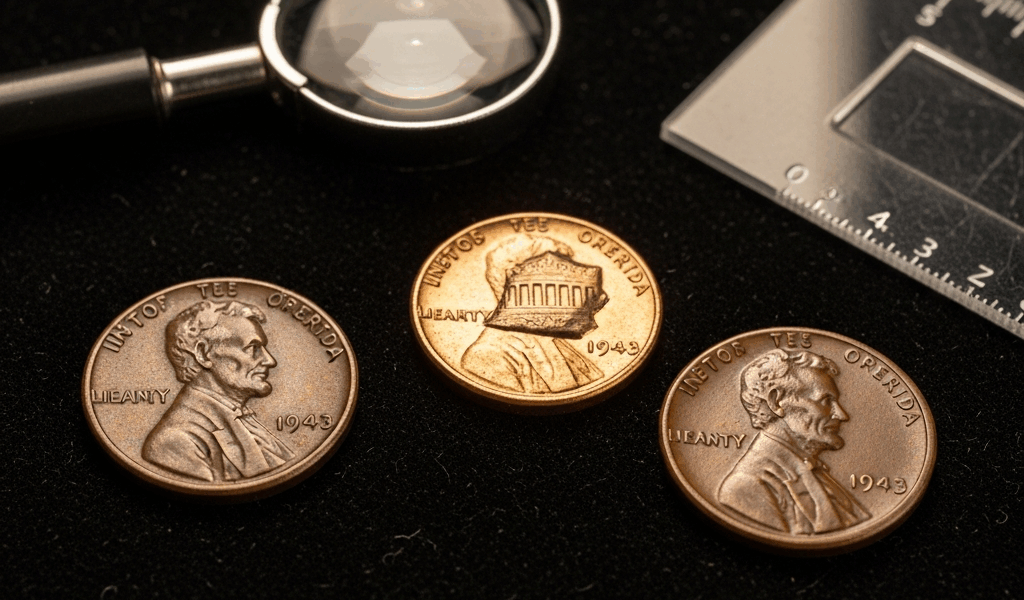
What Is a 1943 Steel Penny Worth
The 1943 steel penny has gotten complicated with all the misinformation flying around. As someone who has spent three years helping friends and family dig through old coin jars and shoeboxes full of forgotten change, I learned everything there is to know about these wartime oddities. Today, I will share it all with you.
Here’s the short answer first: most 1943 steel pennies are worth 10 to 50 cents in circulated condition. Better-preserved examples — ones with original shine and minimal contact marks — fetch $1 to $5. Uncirculated specimens can hit $10 to $20. That’s your baseline for the common ones.
But what is a 1943 steel penny, exactly? In essence, it’s a wartime emergency coin struck from zinc-coated steel instead of copper. But it’s much more than that. The mint mark on the reverse and the actual metal composition can swing the value from pocket change to six figures. That’s what makes this coin so endearing to collectors and so confusing to everyone else. So, without further ado, let’s dive in.
How to Tell If Yours Is Steel or the Rare Copper
Probably should have opened with this section, honestly. Because before any conversation about value makes sense, you need to know what you’re actually holding.
While you won’t need a professional laboratory, you will need a handful of basic items — specifically, a magnet. A small ceramic disc magnet from a hardware store runs about $2. I tested this method myself using a pack of 12 coins and a 40-cent disc magnet I grabbed from the bins at my local Ace Hardware. Works perfectly.
Hold your 1943 penny near the magnet. Sticks firmly? Steel. Doesn’t stick at all? Set it aside — you might have something unusual on your hands.
The U.S. switched to zinc-coated steel for the 1943 penny to conserve copper for military ammunition casings. Steel is magnetic. Copper is not. Five seconds. Zero cost. Do this first. Always.
Now, the copper situation. The Mint never intentionally struck copper 1943 pennies — these are errors, coins accidentally produced on leftover copper blanks from 1942 production. Fewer than 20 confirmed examples exist across all three mint locations: Philadelphia, Denver, and San Francisco. They’ve become legend. One sold for over $100,000 at auction. Another crossed $200,000.
Don’t make my mistake. I once found a darker, reddish-toned 1943 penny in a jar and convinced myself I had something special. Sent it to a professional grading service — $25 in fees later — and got back a verdict of “steel with copper plating.” Probably a numismatic novelty piece from decades ago, or just heavy accumulated patina giving it that copper look. Embarrassing and expensive.
I’m apparently the kind of person who learns lessons the hard way, and PCGS authentication works for me now while guessing never does. Plated steel coins, acid-stripped coins, even coins from different years get misidentified constantly. If your penny somehow truly fails the magnet test — and I mean fails completely with a strong magnet — then professional authentication through PCGS or NGC is your next call, not a celebration.
Value by Mint Mark — P, D, and S
The 1943 steel penny was struck at three facilities. Each mint mark tells a different story about how many were made and what that means for your wallet today.
Philadelphia (No Mint Mark): No letter appears on the reverse below the date. Philadelphia hammered out over 684 million of these in 1943. That’s an enormous number — and it shows in the market. A worn Philadelphia 1943 penny might pull 10 to 15 cents from a dealer. An uncirculated specimen with original zinc luster could reach $3 to $8, depending on strike quality and eye appeal.
Denver (D Mint Mark): Look for the small D to the right of the date on the reverse. Denver produced roughly 217 million coins — considerably fewer than Philadelphia. That relative scarcity gives Denver examples a slight edge. Circulated pieces run 15 to 30 cents. Uncirculated specimens land in the $5 to $12 range. I’ve watched MS-63 graded Denver examples move on eBay’s completed listings for $15 to $20 consistently.
San Francisco (S Mint Mark): Here’s where collectors genuinely perk up. San Francisco struck only 191 million 1943 pennies — the lowest output of the three mints. The S on the reverse is immediately recognizable. A circulated 1943-S still isn’t expensive, maybe 30 to 50 cents. But uncirculated examples show real collector demand. MS-60 to MS-63 graded San Francisco pieces regularly hit $20 to $50. High-grade examples — MS-65 and above — have sold for $75 to $150. That’s where it starts getting interesting.
If you’re holding a 1943-S in what looks like uncirculated condition, that’s the one worth authenticating professionally.
What Condition Does to the Price
Steel pennies from 1943 present a grading challenge copper coins simply don’t face. Steel corrodes. It rusts. A coin that looks shiny under your lamp might still carry dozens of tiny contact marks from rolling around in bank bags for eight decades. Those marks drop grades fast.
Frustrated by my own misidentifications early on, I started examining coins under a 10x loupe I picked up for $8 at a flea market. That was 2021. What I found on a 1943-D I thought was nearly uncirculated — hairline marks everywhere — knocked it two full grades below what my naked eye suggested. Humbling.
Here’s the practical breakdown:
- Circulated (Very Good to Fine): Heavy wear, date and mint mark still fully readable, designs worn smooth in high spots. Worth face value to 50 cents.
- Almost Uncirculated (AU): Light wear on the highest points only, most original luster still present, strike might run soft on the details. Worth $2 to $8 depending on the mint mark.
- Mint State (MS-60 to MS-63): No actual wear, original zinc luster intact, contact marks visible under magnification. Worth $5 to $25 for Philadelphia or Denver, $20 to $75 for San Francisco.
Rust is a value killer — full stop. A single corrosion spot on Lincoln’s cheek can cut value by half or more. Cleaned coins fare just as badly. Someone polishing a steel penny to make it shiny again destroys the original surface characteristics collectors pay a premium for. Leave them alone.
Where to Sell or Get a 1943 Penny Appraised
For a circulated 1943 penny worth 30 cents, a local coin dealer is probably your best option, as the transaction requires no shipping, no waiting, and no fees. That is because the difference between dealer cash-in-hand and online auction proceeds is negligible at that value — but your time isn’t free.
First, you should check eBay’s completed listings — at least if you want real unfiltered market data before walking into any dealer’s shop. Search “1943 penny,” filter by sold items, and you’ll see what buyers actually paid last week. Not asking prices. Actual sales.
Professional grading through PCGS or NGC runs roughly $20 to $30 per coin and provides authentication documentation that serious buyers trust completely. Worth every cent if your coin looks genuinely uncirculated, or if — somehow — it passed the magnet test clean. Otherwise? Skip the grading fees. A dealer’s same-day offer is probably a better return on your time than mailing a 40-cent coin across the country and waiting six weeks for confirmation of what you already suspected.


Stay in the loop
Get the latest numisma news updates delivered to your inbox.