Why the 1878 Morgan Dollar Is Different From Later Issues
1878 Morgan dollar values have gotten complicated with all the misinformation flying around on general coin sites. As someone who has spent years tracking auction results and handling these coins firsthand, I learned everything there is to know about first-year Morgan varieties. Today, I will share it all with you.
Here’s the thing most casual collectors miss: this is a first-year issue. And first-year coins are a different beast entirely. The Bland-Allison Act of 1878 forced the U.S. Mint back into silver dollar production after a 16-year gap — 16 years — and Philadelphia had to spin up fast. That urgency left fingerprints all over the reverse dies. Multiple engravers. Multiple dies. Distinct variations that didn’t exist in later years.
By 1879, the eagle reverse was standardized. Not so in 1878. That first year is a minefield of varieties, which is honestly why most general coin value sites just wave their hands and treat the whole year as one coin. That’s a mistake. A cleaned circulated 1878 Philadelphia might bring $35. A gem uncirculated example with the scarcer reverse variety? Ten times that at auction, easy.
The Mint simply didn’t have the die standardization process in 1878 that it would develop by the mid-1880s. The most visible result is what collectors now call the “tailfeathers varieties” — the number and angle of feathers on the eagle’s tail shifted between dies. Those changes matter enormously to value. That’s what makes this coin endearing to us variety collectors. So, without further ado, let’s dive in.
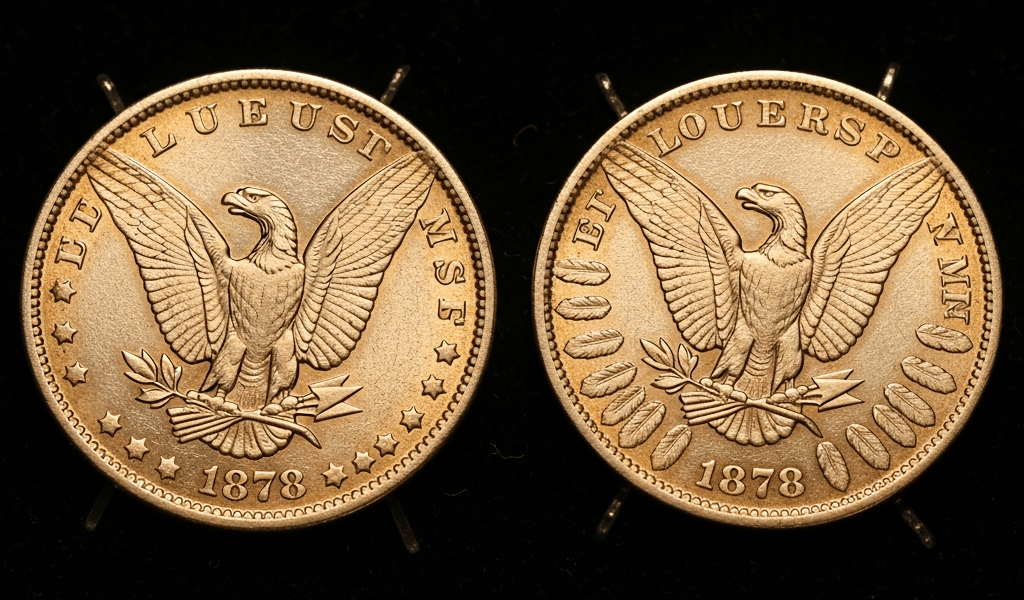
The 8 Tailfeathers vs 7 Tailfeathers Difference Explained
Probably should have opened with this section, honestly. The tailfeathers distinction is the single most important thing you need to identify on an 1878 Morgan. It’s what separates a $40 coin from a $400 coin once you hit high grades.
8 Tailfeathers — The Scarce Reverse
Flip to the reverse — the eagle side, not Liberty’s portrait. Count the feather lines radiating outward from the tail. Eight distinct lines means you have the scarce variety. This die was used early in 1878 production, in far smaller quantities than what came later. The top feathers on the 8-tailfeathers die angle slightly upward, roughly parallel, giving the eagle a distinctive silhouette once you know what you’re looking for.
In circulated grades — VF20 through EF45 — the 8-tailfeathers premium is modest. Maybe $10 to $15 above a comparable 7-tailfeathers coin. But hit MS60 and that premium jumps to $30 or $60. By MS63, you’re looking at $100 or more in added value. This is exactly why grading matters for 1878 Morgans in ways it simply doesn’t for, say, a run-of-the-mill 1890 issue.
7 Tailfeathers — The Standard Reverse
Seven feather lines. This became the standard reverse die late in 1878 and was used exclusively from 1879 onward. But what is the 7-tailfeathers variety exactly? In essence, it’s the common reverse. But it’s much more than that — there are actually two sub-varieties within this group. One has parallel top feathers, the other has angled top feathers. Most dealers don’t bother distinguishing them. The price gap is small, maybe $5 to $10 in high grades, and most buyers don’t ask.
For practical purposes: if you count seven tail feathers on your 1878 Morgan, you have the common reverse. That’s not a bad thing. It just means your value comes primarily from mint mark and grade rather than die variety premium.
How to See the Difference Yourself
While you won’t need a professional grading setup, you will need a handful of basic tools. A 3x to 5x magnifier — I use a $12 Bausch & Lomb loupe I’ve had for years — and decent directional lighting. Hold the coin with the eagle facing you. Focus only on the tail feathers. Count the distinct lines. Use a fingernail to track them mentally if you need to.
Eight is scarcer. Seven is standard. Under good lighting, the difference is obvious once you’ve seen both types side by side. Cleaned or polished coins are another story — die details blur under magnification on those, which is one reason originality matters so much when attributing 1878 Morgans to specific varieties. Don’t make my mistake of trying to attribute a coin with artificial shine. You’ll second-guess yourself the whole time.
1878 Morgan Dollar Values by Mint Mark and Grade
Values vary wildly based on mint mark and condition. Here’s the reality, based on what I’ve tracked across auction results and dealer inventories over the past several years.
Philadelphia (No Mint Mark)
The 1878-P had a mintage of over 7 million coins. It’s the common date of the first year — high production, wide survival, lots of examples on the market.
- VF20 (Very Fine): $30–$45 for the common 7-tailfeathers reverse
- EF45 (Extremely Fine): $45–$70
- MS60 (Uncirculated, light bagmarks): $85–$130
- MS63 (Choice Uncirculated): $140–$200
- MS65 (Gem Uncirculated): $350–$550
The 8-tailfeathers Philadelphia is a different conversation. Add $40 to $60 in circulated grades. In MS60, add $100 to $150. MS63 and above, you’re looking at $200 or more on top of those base figures.
San Francisco (S Mint Mark)
The 1878-S had a mintage around 9 million — slightly more than Philadelphia in raw numbers. Fewer high-grade survivors, though. San Francisco coins typically saw harder use, and gem examples are genuinely harder to find than the mintage number alone would suggest.
- VF20: $35–$50
- EF45: $55–$85
- MS60: $95–$150
- MS63: $160–$240
- MS65: $400–$650
The 8-tailfeathers premium applies here too. The San Francisco version of that variety is particularly scarce — more so than its Philadelphia counterpart — and variety collectors actively hunt it.
Carson City (CC Mint Mark) — The Premium Coin
Here’s where things shift dramatically. The Carson City Mint struck only about 2.2 million coins in 1878. Roughly one-third of Philadelphia’s output. Every single 1878-CC is inherently scarcer, and the market prices them accordingly.
- VF20: $90–$135
- EF45: $130–$200
- MS60: $200–$320
- MS63: $350–$550
- MS65: $1,200–$2,000+
The CC premium is real and consistent. Identical grade, same year — a Carson City coin commands roughly 2.5x to 3x the price of a Philadelphia example. In gem uncirculated grades, that gap widens further. Gem CC Morgans are genuinely rare. One caveat, though: these figures assume original surfaces and no cleaning. A polished 1878-CC that looks like MS63 might actually grade MS60 or below and sell for half the listed price. Original surfaces matter more here than almost anywhere else in the series.
How to Tell If Your 1878 Morgan Dollar Has Been Cleaned
Graders call it “cleaning” or “polishing.” It’s the single biggest value killer for vintage silver dollars — a cleaned coin loses 40% to 60% of its value immediately, sometimes more.
But what does cleaned actually look like? In essence, it’s the absence of original mint luster. But it’s much more than that. Imagine running an uncirculated Morgan under a polishing cloth, or worse, dropping it in a tumbler. The soft, frosted bloom of genuine mint-state luster disappears. What’s left is a bright, plastic-looking reflectivity — mirror-like in a way real mint surfaces never are.
Under a 5x loupe, a cleaned coin shows hairline scratches in the field. They run in one consistent direction — the direction of the cloth or polishing motion. A naturally circulated coin has random wear patterns. An unclean mint-state coin has no scratches at all, just that original frosty texture undisturbed from the day it left the die.
Here’s what I learned the hard way: bright does not mean original. I’m apparently more sensitive to artificial shine than most, and my Bausch & Lomb loupe works for me while naked-eye inspection never does on borderline coins. A naturally brilliant 1878-CC can look almost glossy under room light and that’s completely fine. Put it under magnification in natural window light and you’ll see die texture, cartwheel luster, the real thing. A cleaned coin looks sterile by comparison. Weirdly sterile. Don’t make my mistake of buying based on room-light appearance alone.
PCGS and NGC holders will note cleaning on the certification label. Labels reading “Cleaning,” “Polished,” or “Surface Disturbance” mean the coin has been cleaned and graded accordingly — typically one to two full points below where its appearance might otherwise place it.
Is It Worth Getting Your 1878 Morgan Dollar Graded
The honest answer: it depends entirely on what you have.
First, you should evaluate the grade yourself — at least if you want to avoid spending $25 on certification for a coin worth $45. A circulated 1878-P in VF or EF with original surfaces just doesn’t justify third-party grading. The coin might bring $40 to $70 raw. Certification could add $10 in buyer confidence. You lose money on the deal.
PCGS or NGC might be the best option if you have a high-grade 1878-CC or an uncirculated 1878-P with the 8-tailfeathers reverse, as certification for these coins requires establishing originality. That is because serious collectors and dealers won’t pay gem premiums without a grader’s confirmation that the surfaces are genuine. At MS63 and above, a slab increases value by 30% to 50%. It removes doubt. That doubt is expensive when you’re talking about a $500 coin.
Most 1878 Morgans circulating in old collections today grade VF to EF. Most people who find one expect it to be worth hundreds of dollars. Reality check: expect $40 to $100 depending on mint mark and condition, unless you have the scarcer varieties or a high-grade Carson City example. Get it graded only if you genuinely believe it might hit MS60 or higher.
If you suspect you have something unusual — gem-level eye appeal, exceptional original surfaces, a variety premium coin — contact PCGS or NGC directly. Both will advise on whether submission makes financial sense based on estimated value. Most auction houses also offer free preliminary evaluation if you send clear photos. Stack’s Bowers and Heritage both do this regularly. Use that resource before spending anything on certification fees.



Stay in the loop
Get the latest numisma news updates delivered to your inbox.