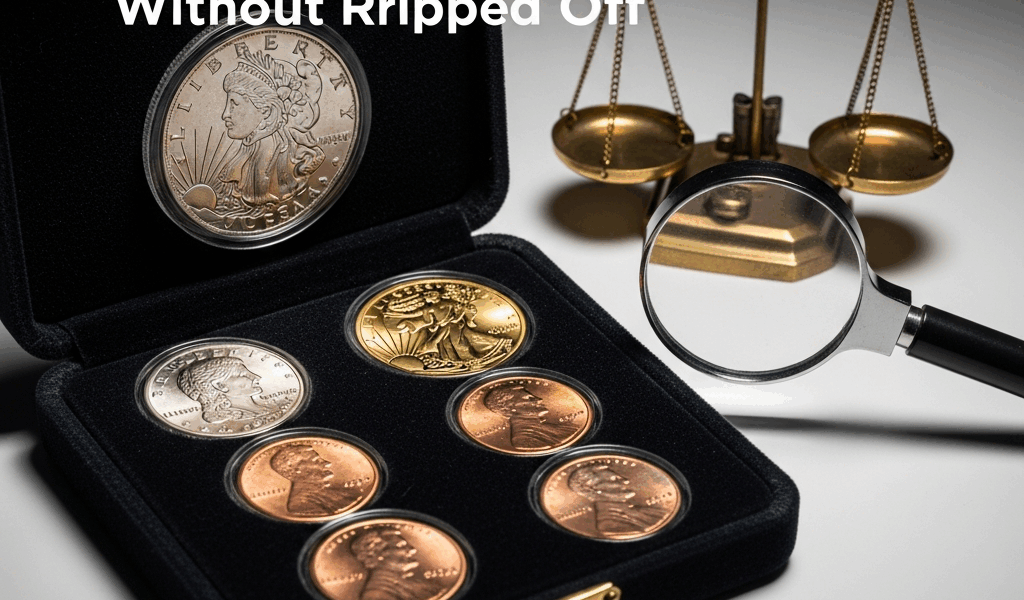
How to Sell Coins — Where to Get the Best Price Without Getting Ripped Off
If you want to sell coins and get the best price, the single most important thing I can tell you is this: slow down. I’ve sold coins through nearly every channel imaginable — local coin shops, Heritage Auctions, eBay, Reddit, coin shows in drafty convention halls — and the sellers who get burned are almost always the ones who took the first offer they received without understanding what they actually had. I’ve been that person. I sold a 1916-D Mercury dime in Fine-12 condition to a dealer for $800 because I thought that was good money, and it was — until I saw a comparable example hammer at $1,400 at auction three weeks later. That mistake cost me real money, and I don’t want it to cost you yours.
This guide isn’t written by a dealer. It isn’t written by a grading company trying to sell you a slab. It’s written by someone who has sat on both sides of the table and learned, mostly through expensive trial and error, how this market actually works.
Know What You Have Before You Sell Anything
Probably should have opened with this section, honestly, because everything else downstream depends on it.
You cannot negotiate effectively if you don’t know what your coin is worth at retail. Dealers know this. They count on it. Before you call a single shop or list a single item, spend real time on identification and valuation using free resources that have no incentive to lowball you.
Free Tools Worth Your Time
The Official Red Book — formally titled A Guide Book of United States Coins by R.S. Yeoman — costs about $15 at any bookstore and is updated annually. The 2024 edition lists retail values by grade for essentially every U.S. coin series. It skews slightly conservative compared to current market, but it gives you a legitimate floor. If a dealer offers you less than Red Book for a common coin in decent condition, that’s a red flag worth noting.
PCGS Photograde is a free online tool at pcgs.com that lets you compare your coin against high-resolution reference images to estimate grade. Grading is subjective and takes years to develop real intuition, but Photograde gives you a defensible starting point. If your 1881-S Morgan dollar looks like the MS-63 image, you know you’re not holding an MS-60 regardless of what someone tells you.
NGC Coin Explorer, available at ngccoin.com, shows realized auction prices for specific coins by grade. This is crucial. Realized prices — what coins actually sold for — matter far more than catalog values. A coin listed at $500 in the Red Book that consistently hammers at $350 at auction is a $350 coin. NGC Coin Explorer shows you the real number.
When Professional Grading Is Worth the Cost
PCGS and NGC charge between $30 and $65 per coin for standard submission, with turnaround times running four to twelve weeks depending on service level. That cost only makes sense in specific situations.
Submit for grading if your coin is potentially worth more than $300 in a certified holder, if it’s a key date or major variety, or if you’re planning to sell through auction where a certified grade meaningfully expands your buyer pool. For a circulated 1964 Kennedy half dollar worth $8, professional grading is economic nonsense. For a 1909-S VDB Lincoln cent in what appears to be EF-45 condition, it’s mandatory before selling.
Raw, uncertified coins sell at a discount to slabbed examples in almost every venue. That discount varies — sometimes 10%, sometimes 40% — but it’s real and consistent. Factor it in.
Where to Sell — Every Channel Compared
There is no single best place to sell coins. The best channel depends on what you’re selling, how much time you have, and how much risk you’re willing to accept. Here’s how each one actually works.
Local Coin Shops
Walk-in coin shops are convenient. They’re also almost always the lowest offer you’ll receive. Dealers operate on margin. They buy wholesale and sell retail. A shop that retails a coin at $200 needs to buy it at $100 to $120 to stay in business. That’s not dishonesty — that’s commerce. But you need to understand that their offer reflects a business model, not the coin’s value to a collector.
Local shops are appropriate for bulk sales of common material — junk silver, wheat cents by the roll, circulated commemoratives — where the transaction cost and time of other channels exceeds the value of the coins themselves. For anything significant, get their offer last, not first.
Heritage Auctions
Heritage is the largest numismatic auction house in the world, and for high-value coins, it’s genuinely competitive. Their buyer’s premium runs 20% on coins sold for under $1,000 and scales down slightly from there. Sellers typically pay a commission of 5% to 10% depending on consignment size and relationship with the house.
The math works if your coin is legitimately rare or desirable. A key-date coin that generates bidding competition at Heritage can dramatically outperform what any dealer would offer. The downside is time — their major auctions are tied to shows like the FUN Convention in January and the ANA show in August, and consignment deadlines are weeks before the sale. You might wait three to five months from drop-off to check.
eBay
eBay is where I sell mid-range material — certified coins in the $75 to $500 range — and it consistently returns better than dealer offers. Final value fees run 12.9% for coins in most categories, plus PayPal or payment processing fees around 3%. So your net on a $200 sale is roughly $168 before shipping costs.
The platform’s strength is reach. Millions of collectors search eBay daily. A well-photographed listing with accurate attribution reaches a national buyer pool in a way a local shop never can. The weakness is time — listing, photographing, packing, and shipping takes real effort — and occasional buyer disputes.
Burned by one too many bad packing jobs early on, I now photograph every coin on a light pad next to a millimeter ruler before it ships and include the image in the listing. It takes four extra minutes and has eliminated disputes almost entirely.
Reddit — r/Coins4Sale
The r/Coins4Sale subreddit is surprisingly functional for selling to other collectors directly. No platform fees. Buyers are generally knowledgeable. Prices typically land between dealer wholesale and eBay retail, which means both sides feel like they got a fair deal. Transactions run through PayPal Goods and Services for buyer protection.
Reputation matters here. New accounts with no selling history move inventory slowly. Build participation in r/Coins and r/coincollecting before expecting smooth sales. For established community members, it’s genuinely one of the better venues for mid-range material.
Coin Shows
Regional coin shows let you walk a floor and get competing offers from multiple dealers in a single afternoon. This is underrated. I’ve gotten meaningfully better prices at shows simply because dealers know you can walk ten feet to their competitor. Bring your coins in individual flips or a binder with individual 2×2 holders. Loose coins in a bag signal that you don’t know what you have.
Major shows like the ANA World’s Fair of Money or the FUN Convention also attract serious collector-buyers, not just dealers, which can push prices higher for genuinely desirable material.
How to Get a Fair Price
The most reliable way to get a fair price is to get multiple offers before accepting any of them. This sounds obvious. Almost nobody does it.
The first offer is always calibrated to the assumption that you’ll accept it. Dealers are experienced buyers making offers to inexperienced sellers dozens of times a week. They know what they can get away with. When you say “let me get a few more opinions,” the dynamic shifts.
Wholesale vs. Retail — Understand the Gap
Retail is what a collector pays to own a coin. Wholesale is what a dealer pays to acquire inventory. The gap between them runs anywhere from 20% to 60% depending on coin type and market liquidity. You will never get retail from a dealer. That’s not how the business works. But you should know what retail is before you evaluate any wholesale offer.
A reasonable dealer offer on a desirable coin in a liquid market is 70% to 80% of current retail. Below 60% of retail for anything other than very common material, and you should walk away and try another channel.
How to Negotiate
Don’t open with your number. Let them make an offer first. If the offer is below what you’re willing to accept, say so directly: “I’ve seen comparable examples sell at auction for $X. Can you get closer to that?” Some dealers will. Some won’t. The ones who won’t are telling you something useful — that their margin requirements mean you should sell elsewhere.
Silence is your friend. Quote the NGC realized price you looked up. Then stop talking. Let them respond.
Common Scams and How to Avoid Them
The coin market has more than its share of people who will take advantage of sellers who don’t know what they have. These are the specific situations that cause real financial damage.
Cash-for-Gold Shops
Cash-for-gold operations buy coins by metal content weight and ignore numismatic premium entirely. A 1921 Morgan dollar contains 0.7734 troy ounces of silver. At $28 spot, that’s about $21 in melt value. A coin shop might pay $22 for a worn example. A cash-for-gold shop might pay $18. A coin worth $35 to $45 in retail to a collector nets you $18 because they don’t know or care about collector value, only metal weight. Never sell numismatically significant coins at melt.
Facebook Marketplace — Fake Buyers
Facebook Marketplace attracts buyers who want to pay with methods that offer them chargeback protection while leaving you exposed. Zelle, Venmo Friends and Family, and Cash App are irreversible from the buyer’s side if something goes wrong, but scammers also generate fake payment screenshots. If you sell locally through Facebook, take cash only, in person, in a public location. For shipped sales, use eBay with its structured dispute process.
Uninsured Shipping
USPS Priority Mail includes $100 of insurance by default. That’s not enough for anything significant. Declare full value and purchase additional insurance through USPS or a third party like Collectibles Insurance Services. A padded envelope is not appropriate packaging for coins worth more than $50. Use a rigid cardboard box, wrap each coin holder in bubble wrap, and fill void space. I once received a package where a $340 PCGS-slabbed coin had shattered inside the slab from inadequate packing. The seller had shipped it in a padded envelope. Insurance paid, but the coin was destroyed.
Cleaning Coins Before Selling
Do not clean your coins. I cannot say this forcefully enough. Collectors and dealers can identify cleaned coins immediately under any magnification. A coin that has been wiped, dipped in jewelry cleaner, or polished with a cloth shows hairline scratches under a loupe that cannot be reversed. Cleaning destroys surface luster and drops a coin’s grade — and therefore its value — permanently. An original, uncleaned coin in VF-20 is worth more than a cleaned coin that looks brilliant but grades “Details — Cleaned” at PCGS or NGC. The grading services straight-grade cleaned coins almost never. They body-bag them, and body-bagged coins sell at massive discounts. Leave the coins alone.
The collectors who do best selling coins are the ones who take their time, learn the market, use multiple channels strategically, and treat every offer as a starting point rather than a conclusion. The market rewards patience and punishes urgency. If someone is pressuring you to decide right now, that pressure is the answer.



Stay in the loop
Get the latest numisma news updates delivered to your inbox.