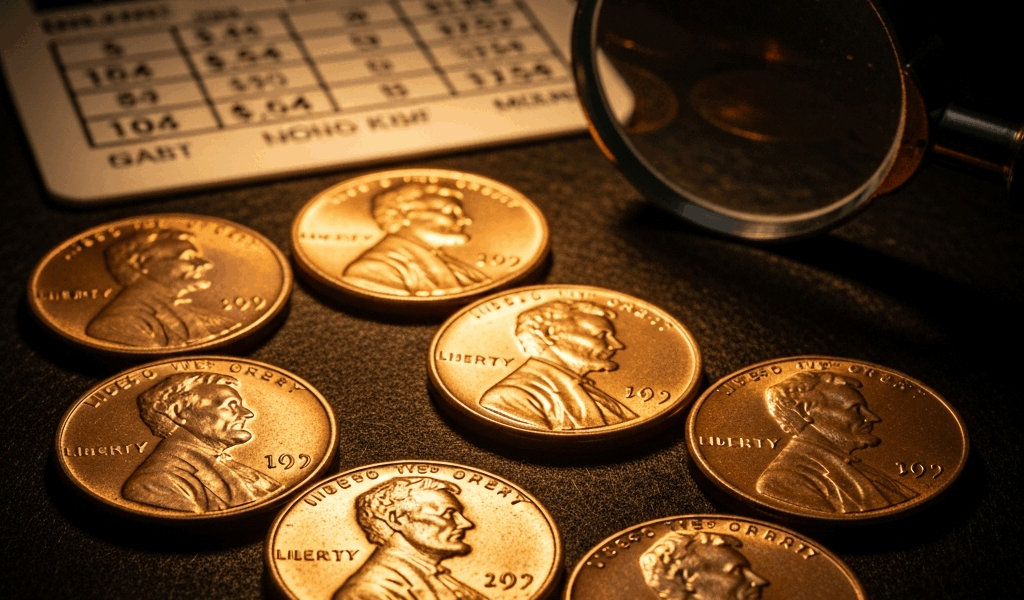
What Is a Lincoln Wheat Penny
Lincoln wheat pennies have gotten complicated with all the misinformation flying around — wild auction claims, YouTube videos insisting every old penny is worth thousands, and your cousin who swears he found one worth a car payment. As someone who’s spent years sorting through inherited collections and flea market hauls, I learned everything there is to know about identifying and valuing these coins. Today, I will share it all with you.
But what is a wheat penny? In essence, it’s a Lincoln cent minted between 1909 and 1958 featuring two wheat stalks on the reverse side — that’s the name right there. But it’s much more than that. The obverse carries Abraham Lincoln’s portrait, the first time a real historical figure appeared on a circulating U.S. coin. Roughly 4.7 billion were struck across three mints. Many spent decades in active circulation before landing in coffee cans, junk drawers, and your grandmother’s mason jar. Most are worth face value. Some are worth hundreds. A rare few are worth more than a house. The trick is knowing which ones you’re actually holding.
How to Read the Mint Mark on a Wheat Penny
Before you can determine value, you need to figure out which mint struck your coin. Look directly below the date on the front — the obverse — of the penny. That tiny letter hiding there is the mint mark. Sometimes there’s nothing at all, and that tells you something too.
Three possibilities exist:
- No mint mark — Philadelphia Mint. Most common. No letter, just the date sitting there alone.
- D — Denver Mint. Appears below the date starting in 1911. D-mint coins frequently command more than Philadelphia issues from the same year.
- S — San Francisco Mint. Smaller production runs, generally higher values. S-mint wheat pennies are almost always worth more than their Philadelphia and Denver counterparts.
I’ll be honest — the first time I checked for a mint mark, I held the coin at the wrong angle for a solid five minutes and saw absolutely nothing. The mark sits low, right beneath where the date ends. Use a 5x loupe or a basic magnifying glass. A $12 loupe from Amazon works fine. You’re not being obsessive; you’re being accurate. Don’t make my mistake.
Key Date Wheat Pennies Worth Real Money
These dates matter. These are the coins that show up in Heritage Auctions, that dealers pull from their cases under glass, that collectors spend decades hunting to complete a full Lincoln set. So, without further ado, let’s dive in.
1909-S VDB
The Holy Grail for anyone just starting out. VDB stands for Victor David Brenner — the designer — whose initials appear on the reverse below the wheat stalks. Frustrated by public outrage over a designer’s initials appearing so prominently on a government coin, the Mint pulled them mid-production using whatever tooling adjustments were available at the time. The San Francisco facility had already struck just 484,000 coins with those initials intact. Circulated condition — worn but readable — runs $80 to $140. Uncirculated examples with original luster fetch $250 to $650 depending on strike quality. A high-grade specimen sold at auction for $920 in 2024.
1909-S (No VDB)
After Philadelphia yanked Brenner’s initials, San Francisco kept striking pennies through the rest of the year — minus the VDB. Fewer total coins than the VDB version. Circulated: $40 to $90. Uncirculated: $150 to $400.
1914-D
Denver’s lowest mintage year in the early series. Just 1.19 million coins struck. Circulated: $25 to $65. Uncirculated: $100 to $300.
1922 Plain (No Mint Mark)
This is the error date everyone chases — and for good reason. Denver was the only mint striking pennies in 1922. Worn dies at the Denver facility produced coins so faint that the D mint mark is nearly invisible, and what you’re left with looks like a Philadelphia issue. Except Philadelphia wasn’t making pennies that year. A legitimate, clean 1922 with no visible mint mark is genuinely valuable. Fair warning though: counterfeits are everywhere. Circulated examples sell for $15 to $60. Well-documented uncirculated specimens reach $200 to $800.
1931-S
San Francisco’s rock-bottom Depression-era mintage. 866,000 coins total. You’ll find this one occupying the centerpiece slot in serious collections. Circulated: $50 to $110. Uncirculated: $200 to $600.
1943 Copper (Error)
During World War II, the Mint switched to zinc-coated steel planchets — those thin coin blanks — to conserve copper for ammunition casings and shell production. A small number of leftover copper planchets accidentally fed into the presses before the switchover was complete. Fewer than 30 authenticated examples exist across all three mints. I learned the hard way that a simple magnet test matters enormously here: real 1943 copper cents are non-magnetic, while the far more common steel versions stick immediately. A legitimate 1943 copper cent in circulated condition has sold for $250,000 to well over $1 million. Counterfeits are rampant — including copper-plated steel fakes and altered dates from 1948 cents.
1944 Steel (Error)
The reverse situation. Steel planchets left in inventory got struck in 1944 after the Mint returned to copper. Even rarer than the 1943 copper — fewer than a dozen confirmed examples exist. Authenticated specimens at auction exceed $800,000.
Semi-Key and Better Dates to Watch For
Not every valuable wheat penny commands four or five figures. These dates occupy a solid middle tier — worth keeping separate, worth considering professional grading, and worth considerably more than the common stuff filling most jars.
1909 VDB (Philadelphia, No S)
Circulated: $8 to $20. Uncirculated: $35 to $150. Still desirable — it’s year one of the series, and Brenner’s initials make it historically significant.
1910-S
Circulated: $6 to $15. Uncirculated: $40 to $120.
1911-S
Circulated: $7 to $18. Uncirculated: $45 to $140.
1912-S
Circulated: $5 to $14. Uncirculated: $35 to $110.
1913-S
Circulated: $6 to $16. Uncirculated: $40 to $130.
1924-D
Circulated: $8 to $22. Uncirculated: $50 to $180.
1926-S
Circulated: $6 to $16. Uncirculated: $45 to $140.
1955 Doubled Die
Another error that captivates collectors — and probably should have been in the key dates section, honestly. The obverse design was stamped twice during production, slightly offset each time, creating a ghosted doubling effect clearly visible on the date and the lettering around Lincoln’s portrait. No magnifier needed on a strong example. Circulated: $80 to $250. High-grade uncirculated: $400 to $1,200. That’s what makes the doubled die endearing to us collectors — it’s a dramatic, visible error anyone can spot once they know what they’re looking at.
Common Wheat Pennies and What They Are Worth
Reality check. Most wheat pennies are common. Genuinely, unremarkably common. The Mint produced billions of them across nearly five decades. Your 1947 Philadelphia cent, your 1952-D, your 1956 with no mint mark — these are worth what the market pays for worn copper plus a tiny collector premium. That’s it.
Coins from 1940 through 1958 in circulated condition typically range from 3 to 15 cents each. A 1940 Philadelphia penny: about 5 cents. A 1950-D: maybe 8 cents. A 1957 with no mint mark: roughly 10 cents. They’re not worthless — they’re just common. There’s a difference.
Here’s what actually matters for these coins: volume. Coin dealers don’t buy individual common cents — at least not at any price worth your time. They buy rolls. Fifty coins per roll, standard. A dealer will pay $2 to $3 for a roll of average circulated common-date wheat cents, which shakes out to 4 to 6 cents per coin. It simply doesn’t pay to sort, photograph, and list individual coins worth a dime each on eBay.
Probably should have opened with this section, honestly. I’m apparently a slow learner and spending an hour photographing a 1951-D Philadelphia cent works for me in theory while actually making money never quite follows. Don’t make my mistake. Sort by decade. Keep 1909–1920 separate from 1940–1958. Pull out the obvious keys and semi-keys listed above. Everything else goes into a bulk lot.
Sell common wheat cents as rolls to a local coin shop, or bundle them with other bulk copper cents and ship to an established online buyer. You’ll recover a few dollars instead of a few cents per hour of effort.
When to Grade, When to Sell Raw
Professional grading through PCGS or NGC runs $25 to $40 per coin at standard service levels — sometimes more depending on the current tier. Only grade coins worth at least $100 in raw, ungraded condition. A 1931-S in uncirculated condition? Send it in. A 1947 in mint state? Don’t. The grading fee alone would exceed any realistic resale premium.
NGC might be the best option for budget-conscious submissions, as wheat penny grading requires consistent turnaround and competitive pricing. That is because PCGS occasionally commands a slight premium for its holder on certain series, which only matters once your coin hits the $300-plus range anyway. For semi-key dates in excellent or uncirculated condition, a graded holder adds legitimacy, buyer confidence, and real resale appeal. For commons, it’s genuinely wasted money.
Your Next Steps
You’ve found wheat pennies — maybe inherited a full collection, maybe pulled a handful from a rolled coin bag at the bank. Here’s the roadmap:
- Sort by date. Four groups: 1909–1920, 1921–1935, 1936–1950, 1951–1958.
- Check mint marks. Look below the date on the obverse — that front side with Lincoln’s portrait.
- Cross-reference your dates against the key dates and semi-key dates listed in this guide.
- For anything matching a high-value date, examine the grade. Circulated or uncirculated? Can you read every detail clearly without straining?
- Research current prices on eBay Sold Listings — not asking prices, sold prices — or check the PCGS Price Guide for recent auction data.
- Decide: grade it if worth over $100 raw, sell it individually if worth $20 to $100, batch everything else into rolls or bulk lots.
Wheat pennies are the most widely collected coins in America. That’s what makes them endearing to us collectors — you don’t need deep pockets to start, just a jar of old coins and a willingness to look twice at the date and the mint mark. Most of what you find will be worth face value or a few cents above it. But the ones that matter — the 1909-S VDB, the 1931-S, the 1943 copper — those are still out there. Sitting in collections, tucked into estate sale shoeboxes, waiting for someone willing to look carefully enough to find them.

Stay in the loop
Get the latest numisma news updates delivered to your inbox.