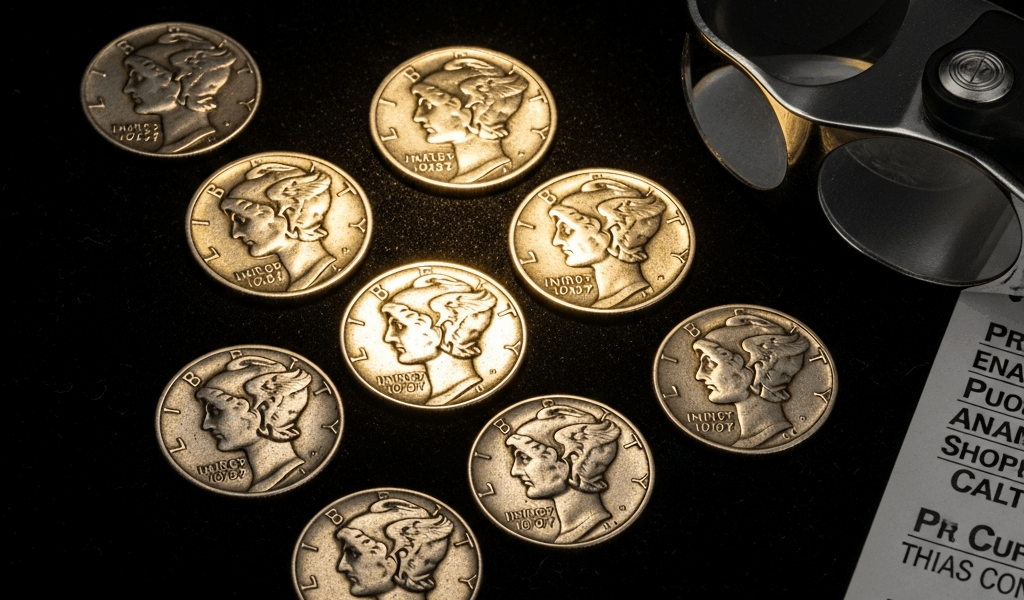
What Makes a Mercury Dime Worth More Than Face Value
Mercury dime pricing has gotten complicated with all the misinformation flying around. Everyone quotes face value like it means something. It doesn’t. We’re talking 10 cents — a number that stopped mattering around 1964.
As someone who has spent the better part of a decade haunting coin shows, flea markets, and Heritage Auctions late-night sessions, I learned everything there is to know about mercury dime value by date and mint mark. Today, I will share it all with you.
Two things actually move the needle on price. Silver melt value is the first one. Every Mercury dime struck between 1916 and 1945 is 90% silver. That means even a beat-up, heavily worn example has a metal floor under it. With silver trading somewhere in the $28–$32 per troy ounce range through most of 2024, a single dime carries roughly $2.00–$2.30 in pure metal content. That’s your baseline — the absolute minimum anyone should accept.
The second factor is date scarcity combined with condition. Some years saw mintages in the hundreds of thousands. Others hit 50+ million. The 1921-D, for instance, had only 1.2 million coins struck in Denver. Compare that to the 1936 Philadelphia issue at 59 million and you start to understand why two dimes that look almost identical can trade at wildly different prices. And then there’s Full Split Bands — a grade designation for uncirculated coins that can literally double a coin’s value overnight. More on that later.
Key Date Mercury Dimes and What They Sell For
Probably should have opened with this section, honestly. These are the coins that make grown collectors abandon their poker faces at a flea market table.
1916-D
The holy grail. Full stop. Denver struck only 264,000 of these in 1916 — a mintage so small it still feels implausible. I’ve watched them sell at Heritage consistently above $400 in Fine-12. A Good-4 circulated example runs $250–$350 on a slow day. Push into uncirculated territory, say MS-63, and you’re shopping in the $2,500–$4,000 range without Full Split Bands. With FSB? Easily $6,000 and climbing.
1921 and 1921-D
The post-WWI years were rough on mintages. The 1921 Philadelphia issue came in at just 1.5 million pieces. Fine-12 examples trade $35–$65. The 1921-D is the scarcer sibling — 1.2 million struck — and pushes $45–$90 in Fine-12. Both coins jump hard once you leave circulated grades behind. A 1921 in MS-63 costs $300–$600. The 1921-D in the same grade? $400–$800. Don’t expect dealer discounts on either.
1942/41 Overdate — Both P and D Mint
This is where die errors collide with scarcity. A 1941 die was reused in 1942, leaving the ghost of the old date visible beneath the new one on the obverse. Roughly 10–15% of 1942 coins from the affected facilities carry this error, depending on which mint you’re examining. The 1942/41-P in Fine-12 runs $20–$45. The Denver version — 1942/41-D — has a lower mintage of that variety and pushes $40–$80 in the same grade. Uncirculated MS-63 without FSB: the P trades $200–$350, the D commands $350–$550.
Semi-Key Dates Worth Knowing
The 1926-S, 1931-D, and 1931-S sit in a comfortable middle tier. Not rare enough to trigger four-figure prices, but uncommon enough that experienced collectors pause. A 1926-S in Fine-12 costs $15–$25. The 1931-D and 1931-S each trade $12–$20 in the same condition. Grab them at spot price or just above. That’s what makes these dates endearing to us collectors — they’re genuinely findable, just not plentiful.
Mercury Dime Value Chart — Common Dates by Grade
This table covers 1916–1945. Built for actual use — bookmark the page and come back when you’re standing in front of a dealer. All prices reflect 2024 market data pulled from PCGS, NGC, and Heritage Auctions sales records.
| Date / Mint | Good-4 | Fine-12 | MS-63 | Notes |
|---|---|---|---|---|
| 1916-D | $250–$350 | $400–$550 | $2,500–$4,000 | Key date; low mintage |
| 1921 | $20–$35 | $35–$65 | $300–$600 | Semi-key |
| 1921-D | $25–$50 | $45–$90 | $400–$800 | Scarcer; semi-key |
| 1926-S | $8–$14 | $15–$25 | $80–$150 | Low mintage S mint |
| 1931-D | $6–$10 | $12–$20 | $60–$120 | Semi-key D mint |
| 1931-S | $6–$10 | $12–$20 | $60–$120 | Semi-key S mint |
| 1942/41-P | $8–$16 | $20–$45 | $200–$350 | Overdate error |
| 1942/41-D | $15–$30 | $40–$80 | $350–$550 | Overdate, D scarcer |
| 1936 | $2–$4 | $3–$6 | $35–$75 | Common date |
| 1940 | $2–$4 | $3–$6 | $30–$70 | Common date |
| 1944 | $2–$4 | $3–$6 | $25–$65 | Common date |
| 1945 | $2–$4 | $3–$6 | $20–$60 | Common date; last year |
For everything not listed — basically 1917 through 1945 minus the standouts above — assume Good-4 values of $2–$5, Fine-12 of $3–$8, and MS-63 of $20–$75. Philadelphia coins carry no mint mark and typically price lowest. Denver (D) and San Francisco (S) struck fewer pieces, so they pull premiums. Simple rule, holds almost every time.
Full Split Bands — Why This Grade Designation Matters
But what is Full Split Bands? In essence, it’s a strike quality designation for uncirculated Mercury dimes. But it’s much more than that — it’s the single most important vocabulary term if you’re buying or selling anything above MS-60.
Flip any Mercury dime to the reverse. You’ll see a fasces — a bundled rod design flanked by an olive branch on one side and an oak branch on the other. A torch sits above it. Behind that torch, two thin parallel bands curve upward. On a well-struck coin fresh from the mint, those bands are crisp, distinct, completely separated. On most uncirculated examples, they’re soft or partially merged — the result of die wear or a planchet that didn’t receive full striking pressure. That’s the difference Full Split Bands captures.
PCGS and NGC both note FSB (sometimes just “Full Bands”) directly on the certification label when a coin qualifies. Dealers know to look for it. Buyers know to ask.
Here’s a concrete number to make this real: a 1945 Mercury dime in MS-65 without FSB trades $150–$250. That same coin in MS-65 FSB? $400–$600. Not a small premium. A doubling — sometimes more depending on the date.
Two caveats worth knowing. First, circulated coins — anything below MS-60 — don’t receive FSB designations. Wear flattens those bands almost immediately. Don’t spend thirty minutes squinting at a Fine-12 coin hunting for sharp bands. It won’t change anything. Second, early dates from 1916–1920 rarely achieve full bands strikes due to the die technology of that era. When they do qualify, the FSB designation on those coins becomes extremely rare and collectible on its own terms.
How to Check Your Mercury Dimes Before You Sell
Frustrated by watching collectors lowball sellers who had no idea what they were holding, I started teaching basic triage at our local coin club using nothing but a $3 loupe from Amazon and a decent desk lamp. Here’s the walkthrough.
Identify the Date and Mint Mark First
The date sits on the obverse — that’s the front — centered below Liberty’s profile. The mint mark lives on the reverse, above the D in DIME. No mint mark means Philadelphia. A small D means Denver. A small S means San Francisco. This one step determines roughly 60% of final value. Do it before anything else.
Assess Wear on Liberty’s Hair
Start at her profile and work backward. The hair bands above her ear and across the back of her head are your primary wear indicators. On uncirculated coins, every strand reads sharp and distinct under a loupe. On circulated examples, wear shows as gradual flattening of those high points. Light wear puts you in Fine-12 to VF-20 territory. Moderate wear lands VF-25 to EF-40. Heavy wear drops to Good-4 through VG-8. This visual check takes about thirty seconds.
Check the Reverse for Damage
Examine the torch, fasces, and branches carefully. Scratches, nicks, and cleaning marks — especially uniform hairline scratches or a dull wiped appearance — destroy value faster than wear does. I’m apparently sensitive to this in a way that borders on obsessive, and PCGS works for me while raw coin assessments never quite do when cleaning is involved. A heavily circulated but untouched dime will outprice a lightly worn cleaned example every single time. Don’t make my mistake of assuming light cleaning “doesn’t count.”
Decide: Raw or Certified
Common date in decent but unremarkable condition? Sell it raw. PCGS and NGC grading fees run $20–$50 per coin — that overhead makes no sense on a $15–$30 coin. Key date, or anything you believe grades MS-63 or higher? Certification makes sense. The holdered label adds credibility and typically justifies a 20–40% premium at a show or on eBay. While you won’t need to certify every coin in your collection, you will need a handful of certified examples if you’re selling anything significant — at least if you want serious buyers taking you seriously.
For more on grading standards and how to photograph coins for online sale, check out our guide to selling vintage coins.

Stay in the loop
Get the latest numisma news updates delivered to your inbox.